Loitering munitions have quietly changed the conflict-zone cockpit. Two operational aids help — but the decisive moment is the half-second after a crew realises what has happened, and how their own startled nervous system behaves next.
More civil crews than ever are planning routes that brush the edges of active conflict. The airspace picture across parts of the Middle East now routinely includes one-way attack drones and loitering munitions — the Shahed-class weapons that transit for hundreds of miles at the same low-to-medium altitudes used for departure, arrival and en-route step-climbs. This is not the familiar small-quadcopter-near-the-perimeter problem. It is a fast, explosive, hard-to-see hazard that the airframe was never designed to survive, moving through the exact volumes of sky where airliners are most vulnerable.
The instinctive question a pilot asks is, how do I protect the aircraft? The honest answer is that an airliner has no active defence, no counter-measure, and no realistic ability to out-manoeuvre a purpose-built munition. Protection is therefore not a flying skill. It is a planning discipline, a decision-making discipline, and — the part most often left out of the briefing — a discipline of managing the crew’s own psychology at the moment things go wrong. This article brings together two aide-mémoire cards the Foundation has published and the human-factors reality that decides whether either one is ever used well.
A threat beyond the certification envelope
To understand why avoidance is the whole game, start with what the structure is actually built to take. A large transport aircraft is certified to withstand the impact of a four-pound bird at cruise speed. That single figure is the airframe’s designed impact tolerance for the windshield, leading edges and structure. It is a meaningful margin against wildlife — and it is nowhere near enough for a drone.
Collision-severity research is consistent: a drone of the same mass as a bird does more damage, because it is rigid and dense. Where a bird deforms and sheds energy across the skin, a drone’s battery, motors and camera concentrate the load and penetrate. A modest drone can already exceed the bird-strike certification case with no explosive at all. A Shahed-class airframe — a couple of hundred kilograms carrying tens of kilograms of warhead, plus blast and fragmentation — is not a marginal exceedance of the envelope. It is orders of magnitude beyond any impact standard that exists. No civil aircraft is certified against a blast-and-fragmentation threat, and none ever will be.
If the structure was never certified against the threat, you cannot armour or fly your way through it. The only real protection is not being where it is.
That conclusion is not defeatist; it is the foundation of the international framework. ICAO Doc 10084 treats conflict-zone weapons as a strategic avoidance problem and weights consequence over probability precisely because the consequence of a hit is catastrophic and effectively fixed. Everything operational flows from that: stay out of the threat volume, keep a geographic margin, and if you must be near it, minimise exposure.
Card one — avoid the band, don’t dodge the drone
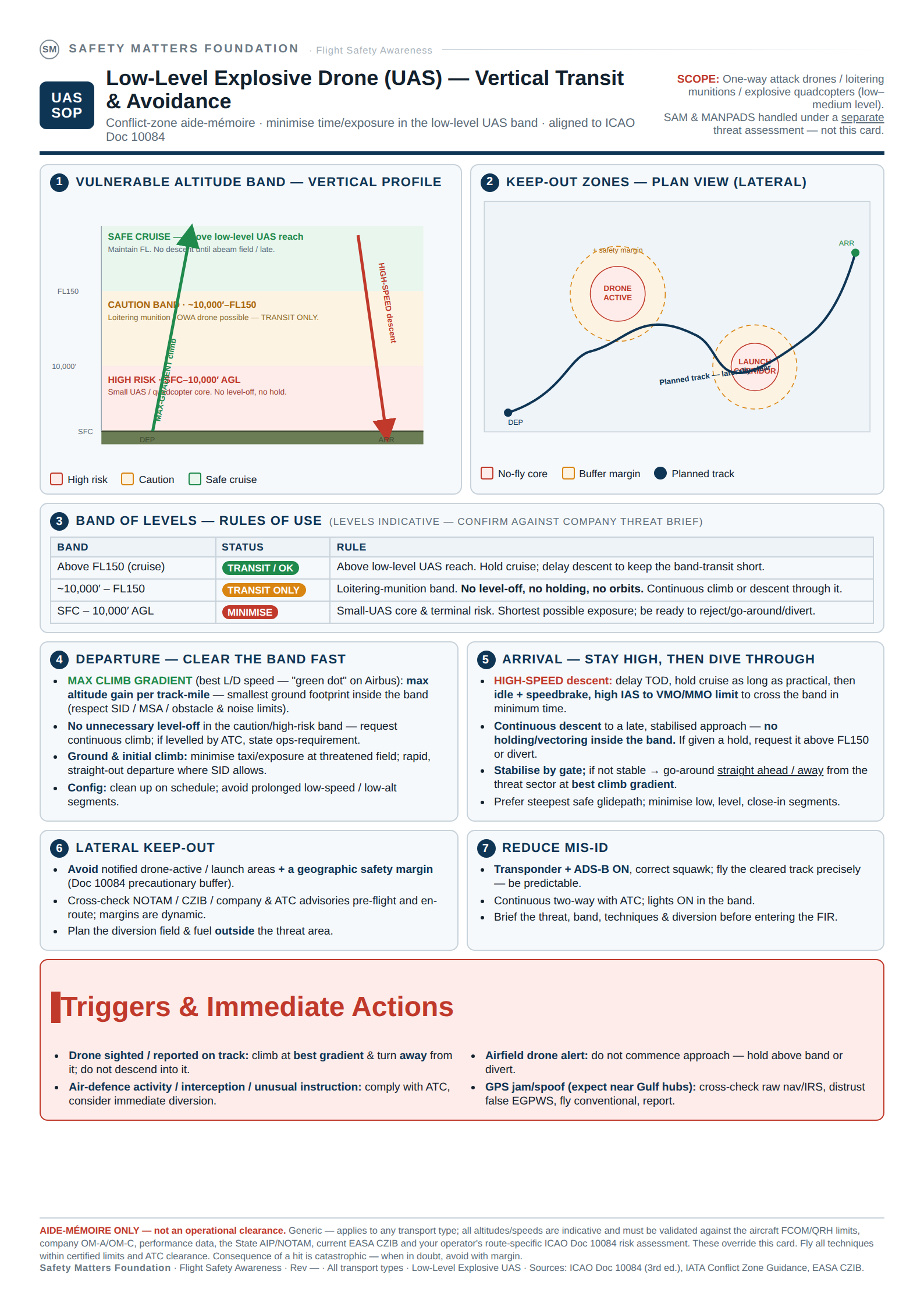
The first aid distils the low-level drone problem into a single page. Its logic is deliberately un-heroic. Rather than teaching a crew to spot and evade — which, as we will see, is close to impossible — it teaches them to spend as little time as possible in the altitudes and areas where the threat lives, and to be predictable so that friendly air-defence does not mistake them for a target.

The card frames three bands: a relatively safe cruise above the low-level threat, a caution band where loitering munitions may reach, and a high-risk band from the surface upward that is also the terminal-area risk. The rules are simple — cross the bands, never loiter in them. On departure that means climbing at the steepest sustainable gradient to clear the band with the smallest ground footprint; on arrival, staying high and delaying the descent, then a continuous, stabilised descent kept firmly within the aircraft’s speed limits. Around it sits lateral avoidance with margin, and the discipline of transponder, precise tracking and continuous ATC contact to reduce the mis-identification risk that has historically killed more airline passengers in conflict zones than any drone.
Card two — when you are hit and still flying
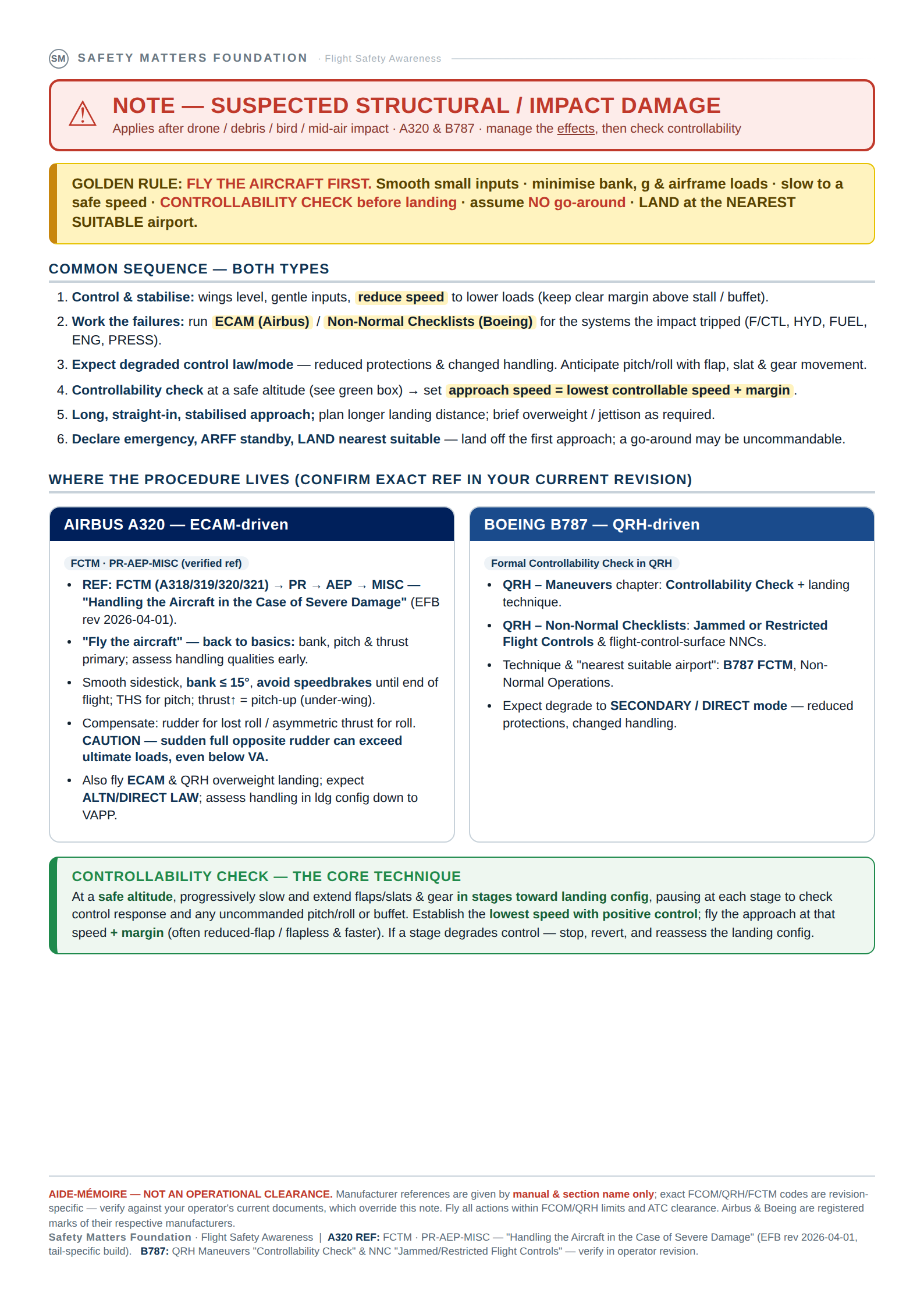
The second aid begins where the first one fails. If avoidance breaks down and the aircraft is struck but remains controllable, the crew is now flying a machine that no checklist fully describes. The card captures the manufacturers’ severe-damage philosophy on one page.

The golden rule is the oldest one in aviation: fly the aircraft first. Airbus’s own guidance tells the crew to revert to “back to basics” flying, using bank, pitch and thrust as primary parameters, and to assess handling qualities early — smooth inputs, bank limited to fifteen degrees, speedbrakes avoided until the end of the flight, and a stern caution that a sudden full opposite rudder can exceed ultimate loads and break the structure even below manoeuvring speed. Boeing gives the crew a formal Controllability Check in the QRH. Both converge on the same destination: establish the slowest speed at which control is still positive, fly the approach faster than that with a margin, assume a go-around may be impossible, and land at the nearest suitable airport. It is careful, deliberate, un-dramatic flying — which is exactly what makes it so difficult in the moments after an explosion.
Composite vs aluminium under impact — and why the visual check can lie
Aluminium is honest about damage. A metal hull is ductile: it dents, bends and tears, soaking up impact energy through plastic deformation, and what you see on the outside roughly reflects the harm done. Cracks then grow slowly and predictably, which is why metal airframes are built “fail-safe” and caught at inspection.
Carbon-fibre composite is not. It is stiffer, lighter and corrosion-free, but far less ductile — it fails by matrix cracking, ply delamination and fibre fracture rather than by denting. The trap is Barely Visible Impact Damage (BVID): a strike can open wide internal delamination while leaving the surface almost unmarked. Under blast and fragmentation the damage can spread further than a comparable metal dent, and confirming it needs ground NDT — ultrasonic, thermography, tap-test — not an eyeball.
So after a strike on a composite aircraft, the visual check can under-read the truth. Assume the internal damage is worse than it looks, handle the aircraft gently, and trust the controllability check over any visual estimate. Neither material survives a direct warhead — the difference is failure mode, energy absorption, and how honestly the damage shows itself.
787 by weight: ~50% composite · ~20% aluminium · ~15% titanium · ~10% steel. Titanium sits wherever there is heat, concentrated load, or a metal-to-composite interface — engine pylons and mounts, landing-gear structure, major wing-to-body and door/window fittings, floor beams, firewalls, and the tens of thousands of fasteners into composite (titanium, unlike aluminium, is galvanically compatible with carbon fibre and will not corrode against it).
The half-second that decides everything: startle and surprise
Here is where the human factors move to the centre of the story, because a card only works if the person holding it can think. An explosive impact is close to a worst-case trigger for two distinct, well-studied human responses, and it is worth separating them.
Startle is the involuntary, physiological reflex to a sudden, intense stimulus — a bang, a flash, a violent jolt, a decompression. It is fast and brief, but for a fraction of a second it captures the body, and motor and cognitive performance dip during and immediately after it. Surprise is different and, for our purposes, more dangerous. It is the cognitive and emotional response to something that violates your mental model — the world is suddenly not what you believed a moment ago. Surprise does not resolve in a fraction of a second. It can drive a brief freeze, a narrowing of attention onto the most salient cue, a loss of the bigger picture, and a measurable degradation in reasoning that can last from several seconds to tens of seconds while the brain rebuilds its model of reality.
An airliner struck by a loitering munition delivers both at maximum intensity at the same instant: the startle of blast and decompression, and the profound surprise of an event most crews have never rehearsed and did not believe would happen to them. The two failure modes that follow are predictable. A startled crew may act before understanding — an instinctive, large control input exactly of the kind that can overstress a damaged airframe. Or they may freeze, losing seconds they do not have. Both are normal human responses, not personal weaknesses, and both are why “fly the aircraft first” is doctrine rather than platitude: the instruction gives the overwhelmed brain a single, pre-loaded first action — stabilise the flight path — that buys the time for the surprise to subside and deliberate thought to return.
The strongest defence against the surprise component is to have imagined the event before it happens. A crew that has briefed the conflict-zone threat, talked through “what if we are hit,” and mentally rehearsed the first three actions no longer meets a model-shattering novelty — they meet an expected, if rare, scenario. Threat briefings and mental rehearsal do not remove startle, but they measurably shrink the surprise, and with it the freeze.
Why you cannot simply see it and evade
Pilots are trained on “see and avoid,” and it is tempting to assume that vigilance plus a hard manoeuvre offers a last line of defence. Against a drone, that assumption is close to false, and it is important to say so plainly so that no crew wastes the decisive seconds trying.
Begin with the geometry. An object on a genuine collision course sits on a constant relative bearing — it does not appear to move across the windscreen. The human visual system is exquisitely tuned to detect relative motion and almost blind to a stationary point against a complex background. A converging drone therefore produces a tiny, motionless, low-contrast image that the eye simply does not pick out, until the final second or two when its retinal image expands explosively in the “looming” that arrives far too late to use. Layer on the practical reality: drones are small and often deliberately low-contrast; classic see-and-avoid studies suggest something on the order of twelve seconds is needed from detection to completed avoidance, while the closing geometry of a jet and a munition can offer only a handful; add empty-field myopia, the blind spots created by cockpit structure, a single pilot with eyes inside running a checklist, and — at night — effectively no chance at all.

There is a further, less obvious limitation, and it compounds the first: the eye is very poor at placing a distant object in three dimensions. Binocular depth perception (stereopsis) is useful only to a few metres and gives nothing for something hundreds of metres away; beyond that the brain infers distance from monocular cues — known size, texture, haze, motion parallax and a horizon reference — and a small drone against featureless sky offers almost none of them. Its true size is unknown, so a small object close by and a large one far off cast the same image (the size–distance ambiguity); there is no texture or horizon to anchor it, and at altitude often no ground reference at all.
The consequence is severe. Even after a crew finally catches the speck, they cannot reliably judge how far away it is, how fast it is closing, or — critically — whether it is above, below or at their own level. Relative height, the one cue an evasion decision depends on, is precisely what the eye cannot read against open sky; a climb or descent chosen blind can steer into the threat as easily as away from it. Empty-field myopia (the unfocused eye resting a metre or two ahead) and, at night, autokinesis — a fixed light that appears to drift — erode the picture further.
Even in the rare case a crew does see it, an abrupt evasive manoeuvre risks the very structural overstress the damage checklist is written to prevent. Detection-and-evasion is not the layer that saves you. Planning and avoidance is.
This is not an argument against vigilance; it is an argument against relying on it. The protective effort belongs earlier — in the route decision, the altitude plan, the keep-out margin — precisely because the cockpit-window defence is so weak.
Perspectives: the human in the loop
Threat is perceived, not simply measured, and perception varies. A crew flying its twentieth uneventful sector through the same region is fighting the quiet erosion of vigilance that psychologists call normalisation — the sense that because nothing has happened, nothing will. Commercial and schedule pressure pulls the same direction, nudging a crew toward pressing on where a dispassionate reading of the risk assessment would divert. The single-pilot or high-workload operator faces this with less spare mental capacity to begin with; a two-crew flight deck has more, but only if it has a genuinely shared mental model and the crew-resource-management habits to voice a concern and change a plan. There is, too, the simple human weight of flying through a place where people are shooting at each other — a background stress that erodes sleep, sharpens fatigue, and narrows judgement over a roster of such flights.
These perspectives matter because the operational aids only function inside a culture that lets a crew act on them. A precautionary diversion, a refusal of a route, a decision to hold high rather than accept a descent into the band — each must be genuinely supported, not quietly penalised, or the human beings in the loop will learn to stop making them.
After the impact: the cascade
If the worst happens and the aircraft is hit yet flyable, the crew does not face one problem. They face a cascade, and each element multiplies the human-factors load already imposed by startle and surprise.
An explosive strike will very likely breach the pressure hull, so a rapid or explosive decompression arrives simultaneously with the impact — noise, fog, cold, and the immediate need for oxygen. That creates a genuine dilemma the crew must resolve while startled: a decompression demands a descent, but structural damage demands that the descent be gentle, speed-limited and free of the aggressive speedbrake and high-speed technique a normal emergency descent would use. On a fly-by-wire aircraft the control law may have degraded, changing the feel and removing protections; automation, if it still engages, may behave erratically and must be watched and dropped without hesitation. Add the possibility of spatial disorientation, of crew or passenger injury, of smoke or fumes or fire, of navigation and communication degraded further by the jamming that so often accompanies these environments — and the crew must nonetheless find a safe altitude that trades terrain clearance against the very threat band they were trying to leave, complete a controllability check, and commit to a landing they may not be able to go around from.
No single checklist covers that combination, and no crew rises to it by luck. They fall back to the level of their preparation: fly the aircraft, deal with the effects one at a time using the tools they have already rehearsed, protect the structure, and land. The cascade is survivable, but only for a crew that has pre-loaded the decisions so that the startled, saturated brain has a rail to follow rather than a blank page.
Reconciling instinct with airmanship
Everything above points to a single reconciliation. The instinct, when a threat appears, is to dodge it. The airmanship is to have avoided it in the first place, and — if that failed — to fly the damaged aircraft gently and deliberately rather than fling it around. The two cards are not clever flying techniques; they are cognitive aids, designed to pre-load the small number of correct first actions so that they are available at the exact moment human performance is at its worst. Brief the threat so surprise becomes expected surprise. Plan the avoidance so the weak cockpit-window defence never has to be tested. And if the aircraft is struck, stabilise first, protect the structure, and work the effects one by one.
There is a final, cultural link in the chain, and it is the one the Foundation returns to most often: reporting. The crew that survives a high-load event, a near miss, a jamming encounter or a strike owes the next crew an honest account of it. Every reported event sharpens the threat picture, refines the avoidance, and — through the maintenance and airworthiness process — keeps the airframe safe to fly again. Safety is not the heroism of the evasive turn. It is the unglamorous sum of good planning, honest reporting, and a crew that has already imagined the worst before it arrives.
The one-page aide-mémoire cards
Download and print for the flight bag. Awareness aids only — not operational clearances.
⬇ Low-level drone SOP (image)⬇ Structural damage note (image)
<
p style=”font-size:0.9em;color:#666″>Sources & further reading: ICAO Doc 10084, Risk Assessment Manual for Civil Aircraft Operations Over or Near Conflict Zones (3rd ed.); IATA Conflict Zone Guidance (2024); EASA Bird Strike Study and Drone Collision Task Force report; Airbus Safety first #26, “High Load Event Reporting”; Airbus FCTM, “Handling the Aircraft in the Case of Severe Damage”; SKYbrary, Flight Control Malfunctions and startle/surprise management literature.
Published by the Safety Matters Foundation for awareness and training discussion only. This article is not an operational clearance or a substitute for approved company procedures; all techniques and references must be validated against the aircraft FCOM/QRH, company Operations Manual, State AIP/NOTAM, current EASA CZIB and the operator’s route-specific ICAO Doc 10084 risk assessment, which take precedence.
Discover more from Safety Matters Foundation
Subscribe to get the latest posts sent to your email.