Even if fuel was cut, the RAT would still deploy much later
In the aftermath of an aviation accident, there is a strong human tendency to search for a single decisive act: a switch moved, a lever pulled, a moment that explains everything. In the case of the AI171 accident on 12th June 2025, a theory has emerged suggesting that a pilot deliberately cut fuel to the engines, with the later deployment of the Ram Air Turbine (RAT) cited as supporting evidence.
At first glance, the sequence sounds intuitive: fuel is cut, engines stop, emergency systems deploy.
But aircraft are not designed around intuition. They are designed around physics, inertia, and deliberate delay. And when those are taken seriously, the timeline itself shows why the “pilot fuel cutoff” theory does not hold up — even if we assume fuel was cut.
Readers are encouraged to read the timeline carefully. If we work forward from Fuel Control Switches transition to Cutoff, we get one RAT deployment timeline, but if we work backwards from when Eng N2 went sub-idle, and RAT started supplying Hydraulic power, we can infer that there was an Electrical issue causing the RAT deployment, and the Fuel Control Switches transitioned to Cutoff later.
Start by assuming the strongest case
To be absolutely fair, let us assume the most extreme scenario:
Assume that one of the pilots moved the fuel control switches to CUTOFF at 08:08:42 UTC.
We will not argue intent or motive. We will ask only one question:
What must the airplane do next, by design and by physics?
Fuel cutoff stops combustion — not motion
When fuel is cut to a jet engine, combustion stops almost immediately. What does not stop immediately is the engine itself.
Jet engines are large rotating systems. After fuel cutoff, they continue to spin because of:
rotational inertia of the compressor and turbine,
airflow through the engine as the aircraft moves forward (windmilling).
This continued rotation is not incidental. It is central to understanding why emergency power does not appear immediately.
Electrical power depends on rotation, not fuel
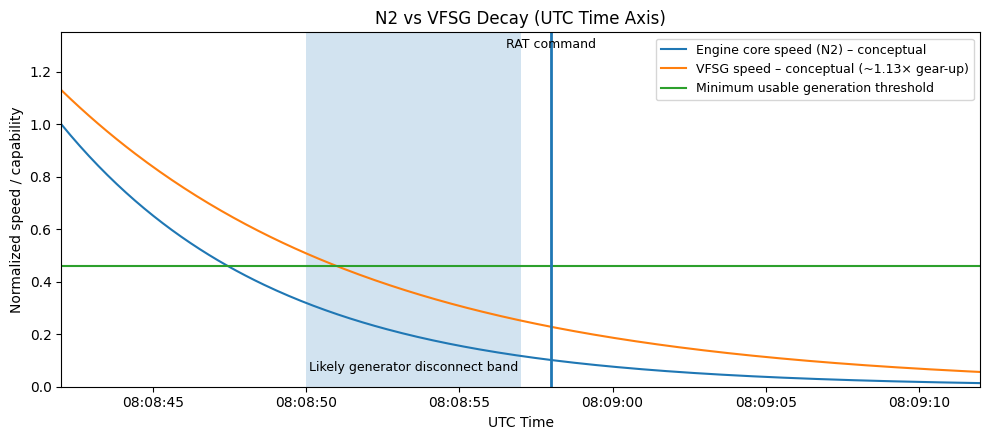
Figure 1 — Generator power decays after fuel cutoff, not at it After fuel cutoff at 08:08:42 UTC, engine speed decays gradually. Due to gearbox gearing, the generator (VFSG) remains above its minimum usable threshold well below idle. Generator loss therefore, occurs several seconds later, and only after that is the RAT commanded.
The airplane’s generators are driven by engine rotation, not by fuel flow. As long as the engine is turning fast enough, the generators can continue to produce usable electrical power — even while thrust is rapidly decaying.
Here a critical technical detail matters.
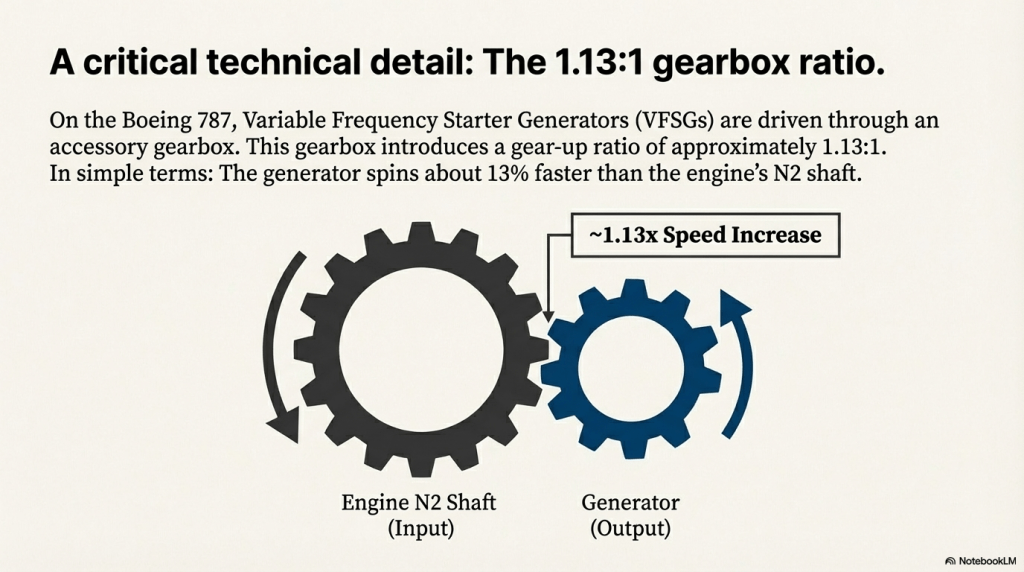
On the Boeing 787, the engines drive Variable Frequency Starter Generators (VFSGs) through the accessory gearbox. The commonly referenced minimum value of about 7400 RPM (≈370 Hz) applies to the generator rotor, not to the engine’s N2 shaft.
The gearbox introduces a gear-up ratio of approximately 1.13:1. In simple terms:
The generator spins about 13% faster than the engine reference speed driving it.
This means the engine can be well below idle and still be producing usable electrical power.
This behaviour is routinely observed in normal operations. During taxi-in, when an engine is shut down, thrust disappears first. Generator “OFF” indications appear seconds later. That delay is intentional.
What speed actually marks the loss of generation
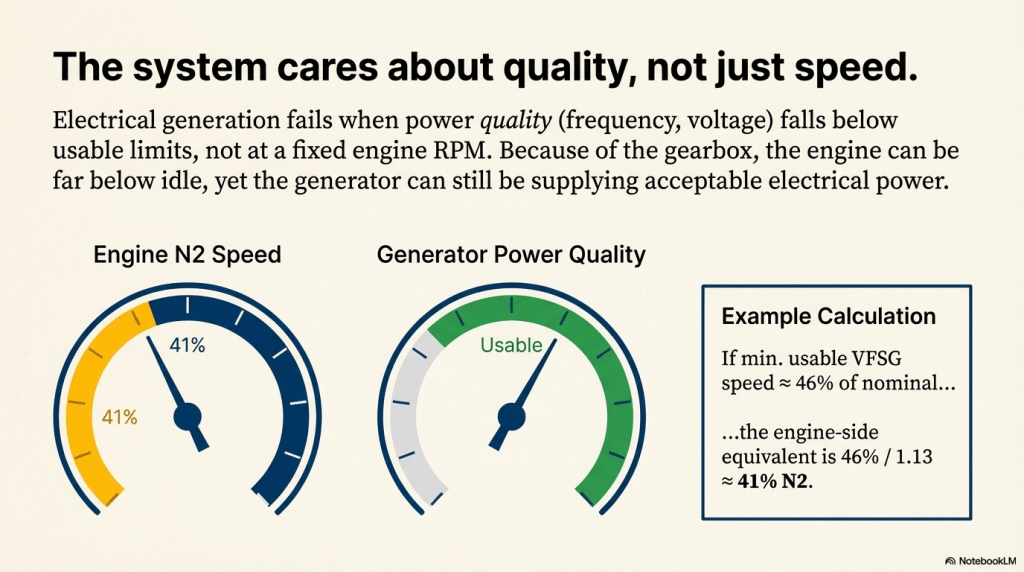
Electrical generation does not fail at a fixed engine RPM. It fails when generator speed and quality fall below usable limits.
Using deliberately conservative assumptions for illustration:
Let the minimum usable VFSG speed be on the order of 46% of nominal (an order-of-magnitude figure, not a certification value).
With a gearbox ratio of ~1.13, this corresponds to an engine-side equivalent of roughly:
In other words:
The engine can be far below idle,
yet the generator can still be supplying acceptable electrical power.
The system does not care that the engine is “slow.” It only cares whether the electricity is still usable.
Generator loss is a window, not an instant
After fuel cutoff, engine speed decays continuously, not in a step. As speed decays, generator frequency and voltage degrade gradually. There is therefore no single instant where fuel is cut, and electrical power disappears.
Instead, there is a window of time during which generator quality crosses unacceptable limits.
Even with aggressive assumptions about deceleration, this window appears several seconds after fuel cutoff, not at the moment fuel is removed.
A conservative, physically consistent sequence looks like this:
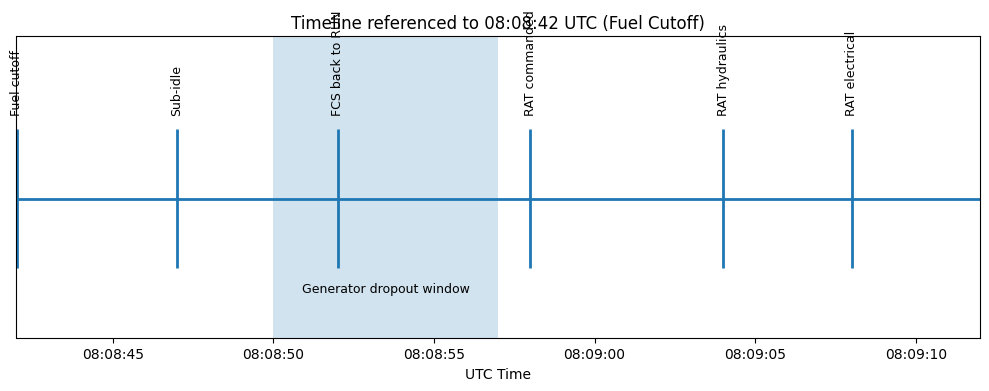
08:08:42 — fuel cutoff (hypothetical)
~4–6 seconds later — engines pass below idle
~8–15 seconds later — VFSG speed and quality fall below usable limits
After that — normal electrical power is declared unavailable
Only then — RAT deployment is commanded
This ordering is dictated by inertia and gearing, not by crew intent.
The RAT does not respond to switches
Figure 2 — Event sequence referenced to 08:08:42 UTC Fuel cutoff, generator loss, and RAT deployment occur in a fixed order dictated by physics and system logic. The RAT is commanded only after the generator output becomes unusable, regardless of pilot intent or subsequent switch position.
The Ram Air Turbine is not a reaction to fuel switches or engine shutdowns. It is a reaction to confirmed loss of normal electrical power.
The airplane does not ask:
“Why did power degrade?”
“Who moved which switch?”
It asks only:
“Is usable electrical power still available?”
As long as the answer is yes, the system waits. Only after the answer becomes no does the RAT deploy.
This guarantees a fundamental inequality in time:
This inequality must always hold.
Why restoring fuel does not change the sequence
Even if fuel switches are returned to RUN a few seconds later, the system does not instantly rewind.
By that point:
the engines have already decelerated,
generator quality may already be outside limits,
the electrical system is responding to measured state, not switch history.
Thus, it is entirely possible — and entirely logical — for:
fuel switches to be back in RUN,
and the RAT to deploy later anyway.
That outcome does not imply sustained or deliberate fuel cutoff. It reflects delayed electrical collapse following rotational decay.
What the timeline therefore proves
When the physics and logic are laid out clearly, the conclusion becomes unavoidable:
RAT deployment timing cannot be used as evidence of pilot intent.
At most, it tells us when electrical power became unavailable. It tells us nothing about:
why fuel was interrupted,
how long it remained interrupted,
or whether the action was deliberate, inadvertent, or systemic.
Confusing outcome with cause is a classic investigative error.
The core takeaway
Here is the entire argument in one sentence:
Fuel cutoff happens instantly; electrical generation decays over seconds; emergency power always comes later by design.
That delay is not suspicious. It is not incriminating. It is how the airplane protects itself.
When the available data are aligned to minimise internal contradictions, the most consistent sequence is one in which electrical power degradation occurred first, around the time the aircraft became airborne, with engine decay following later, rather than the reverse. RAT deployment logic is driven by electrical availability, not by engine speed alone, and an electrical failure can exist transiently while engines continue to rotate and even produce thrust. In this interpretation, the onset of RAT hydraulic supply at approximately 08:08:47 UTC reflects an early electrical event, while the subsequent passage of both engines below idle represents a downstream mechanical consequence rather than the initiating cause. This ordering better reconciles the EAFR hydraulic timing, generator and RAT logic, and N2 behaviour, and cautions against assuming that engine failure must necessarily have preceded electrical loss.
What comes next
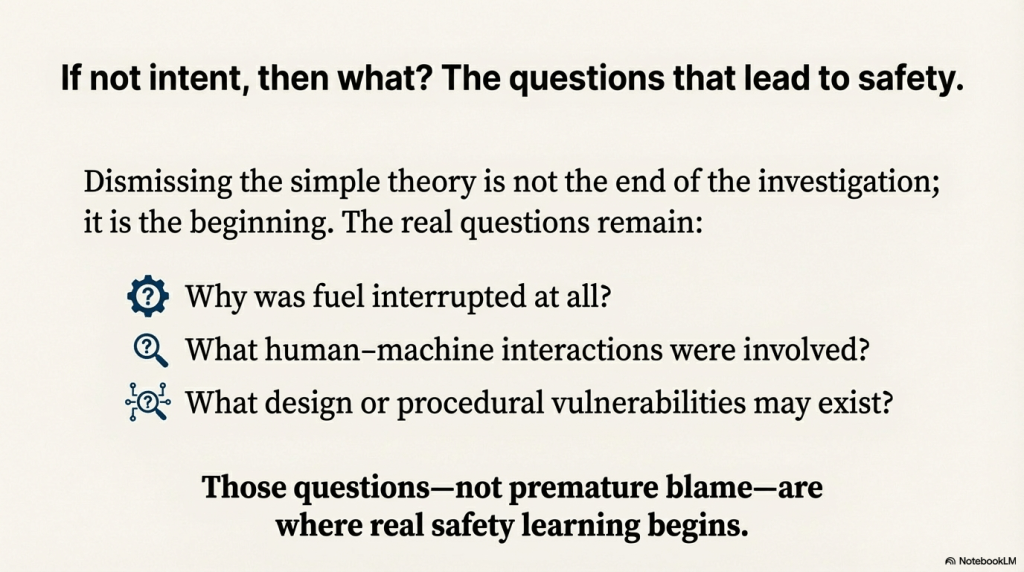
If deliberate pilot intent does not explain the sequence, the real questions remain:
Why was fuel interrupted at all?
What human–machine interactions were involved?
What design or procedural vulnerabilities may exist?
Those questions — not premature blame — are where real safety learning begins.



Leave a Reply