


When Aircraft Must Be Right the First Time
Concorde, the Failed Boeing SST, and the Pressure Cycle in Modern Commercial Aviation
1. Concorde: An Aircraft That Had to Be Right Under Pressure
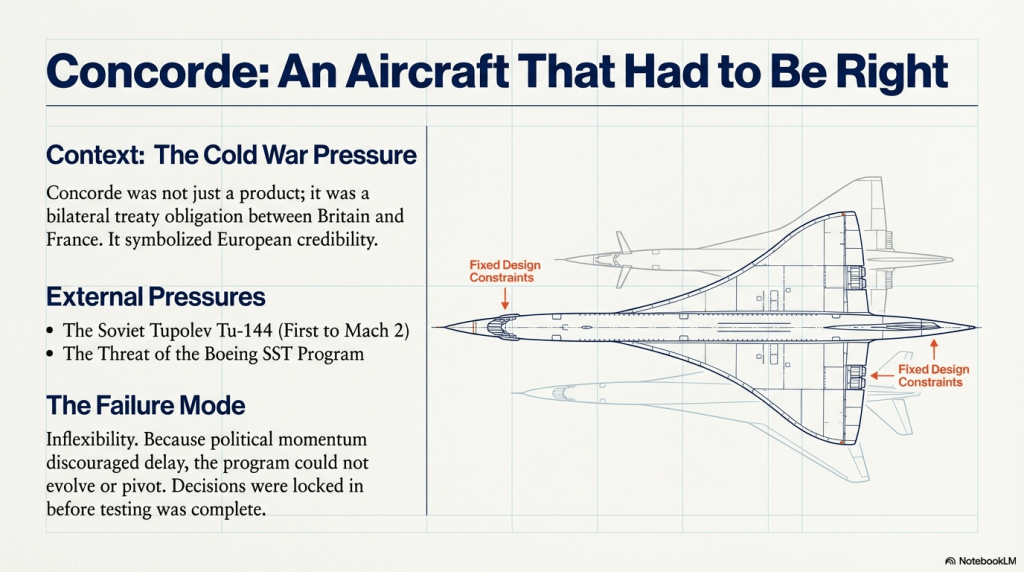
The Anglo-French Concorde was developed under extraordinary political and strategic pressure. It was not merely a commercial project; it was a bilateral treaty programme and a symbol of European technological credibility during the Cold War.
That pressure was compounded by two external factors:
- The Soviet Union’s Tupolev Tu-144, which flew before Concorde and briefly achieved Mach 2 first.
- The announced U.S. supersonic transport (SST) programme, which threatened to eclipse Concorde commercially if Europe did not act decisively.
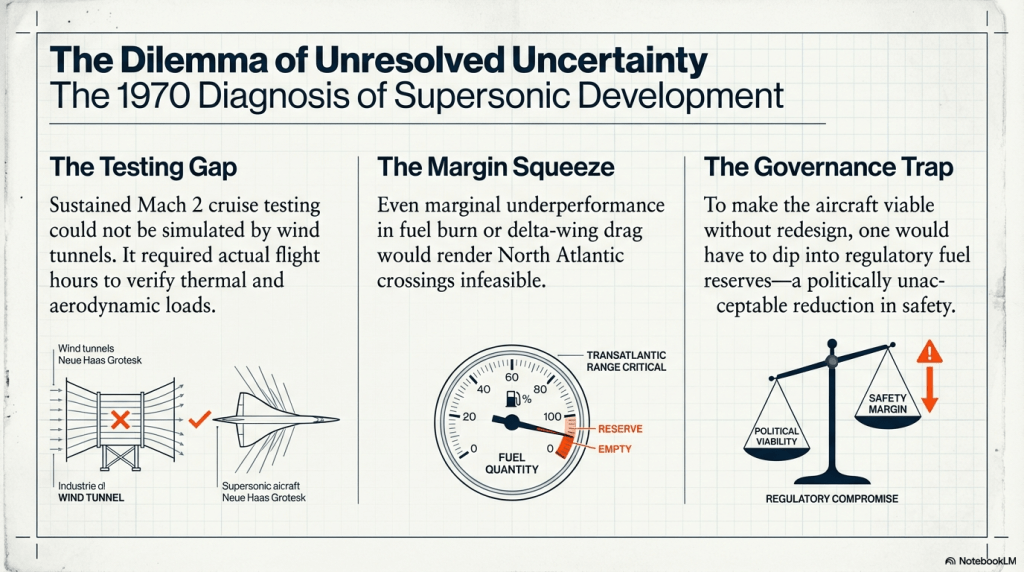
As contemporaneously observed by The Economist in May 1970—later entered into the U.S. Congressional Record by Representative Henry S. Reuss—Concorde faced a structural dilemma: its most critical cruise-speed trials had not yet been completed, yet political momentum discouraged any major redesign or delay.
The Economist explicitly warned that:
- Sustained Mach 2 cruise testing was irreplaceable by wind-tunnel or computational work.
- Even marginal underperformance in fuel burn or delta-wing aerodynamics could render North Atlantic crossings infeasible without compromising regulatory fuel reserves.
- Any reduction in such reserves would be perceived publicly as a reduction in safety margins and could be politically unacceptable.
This was not hindsight. It was a contemporaneous diagnosis of schedule pressure colliding with technical uncertainty.
Concorde ultimately proved technically sound but commercially constrained. Its failure was not one of immaturity, but of inflexibility: once committed, it could not evolve.
2. The Boeing SST: Pressure Without Obligation
In parallel, the United States pursued its own SST through the Boeing 2707. Like Concorde, it was driven by Cold War competition, national prestige, and technological ambition.
However, when cost escalation, environmental opposition, and uncertain market viability converged, the U.S. Congress terminated the programme in 1971. The aircraft never entered service.
This distinction is critical:
- The Boeing SST was cancelled before entry into service.
- Concorde could not be cancelled without profound political consequence.
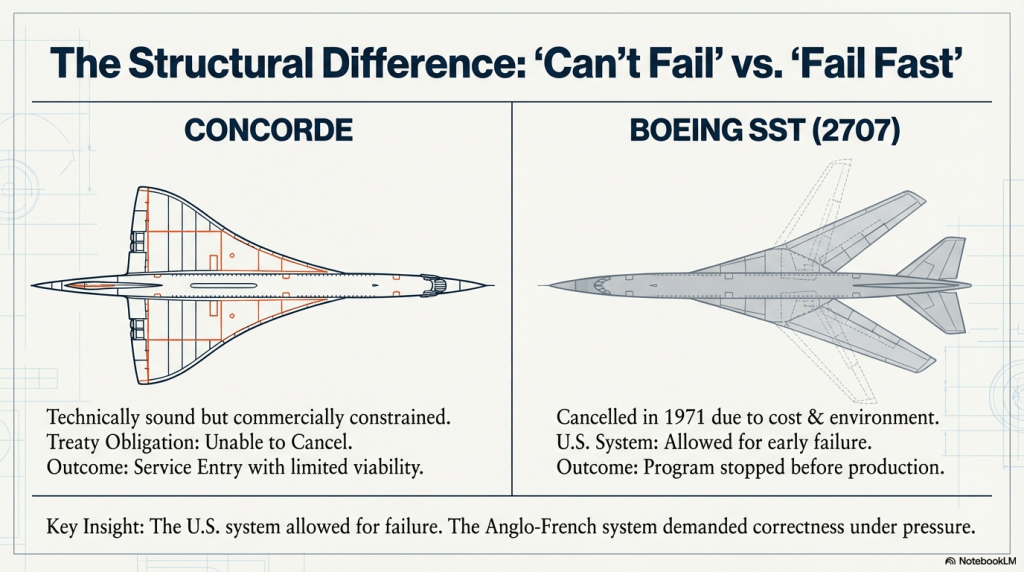
The result was an enduring asymmetry: one system allowed early failure; the other demanded early correctness.
3. The Economist’s Enduring Warning

The 1970 Economist article is pivotal because it articulated—before later events—the core governance risk in complex aviation programmes:
When schedule pressure precedes the resolution of critical uncertainties, the hidden trade is not between delay and cost, but between performance margin and safety margin.
That warning would echo decades later.
4. The Return of Pressure: Boeing and Airbus in the Modern Era

By the early 2000s, global civil aviation had consolidated into a duopoly between Boeing and Airbus. Competitive pressure was no longer ideological; it was commercial.
The structural dynamics, however, were familiar.
5. The Boeing 787: Entry Into Service with Managed Immaturity
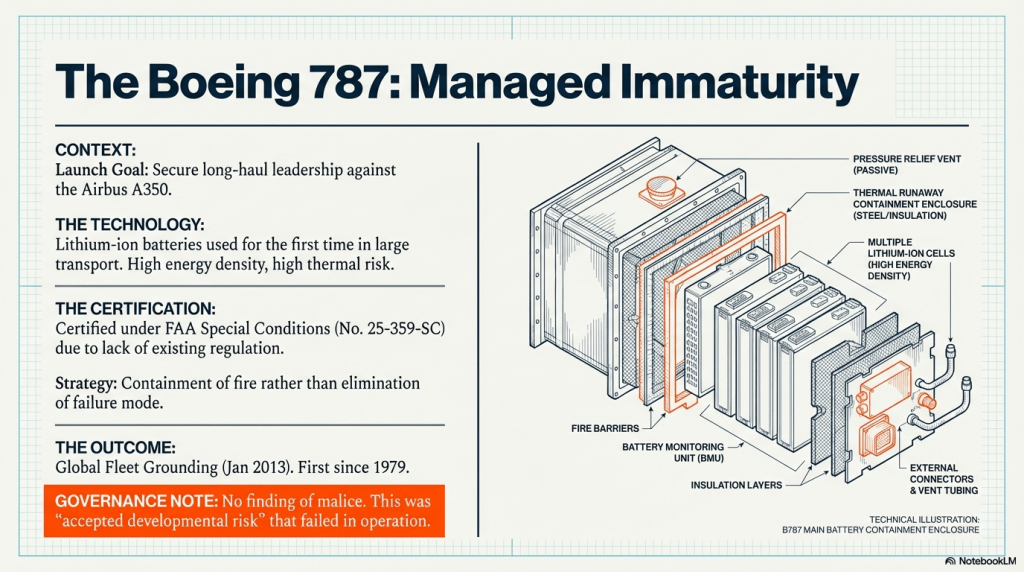
The Boeing 787 Dreamliner was launched to secure long-haul market leadership as Airbus pursued its own next-generation wide-body strategy, later embodied in the Airbus A350.
Public regulatory records establish that at entry into service in 2011:
- The 787 employed lithium-ion batteries, a technology not previously used in large transport aircraft, and certified under FAA Special Conditions because existing regulations did not explicitly address such batteries (FAA Special Conditions No. 25-359-SC).
- The original certification approach relied on containment and mitigation of potential battery failures rather than a demonstrated elimination of all credible failure modes (FAA/NTSB investigation records, 2013).
- Subsequent NTSB investigations noted that system-level interactions between batteries, charging systems, and aircraft electrical architecture required further evaluation following in-service events.
These points are documented in FAA airworthiness directives and NTSB factual and final reports following the January 2013 grounding—the first grounding of a U.S.-certificated airliner type since 1979.
No fatalities occurred, and Boeing redesigned the system post-certification. The programme continued.
Importantly, no court or regulator concluded that the aircraft was intentionally unsafe; rather, the record shows accepted developmental risk that required correction after operational exposure.
6. The Boeing 737 MAX: Pressure With Less Margin

Competitive pressure intensified in the narrow-body market following the launch of the Airbus A320neo, which offered significant fuel-efficiency improvements with minimal pilot retraining.
Boeing responded with the Boeing 737 MAX, an accelerated derivative of an existing airframe intended to preserve fleet commonality.
Subsequent investigations and legal proceedings established that:
- Certain system characteristics introduced by the MAX design were mitigated through software augmentation.
- Information provided to regulators about the scope and behaviour of that software was incomplete.
These findings are set out in the U.S. Department of Justice Deferred Prosecution Agreement:
- United States v. The Boeing Company, No. 4:21-cr-00005 (N.D. Texas).
The legal issue was not competition or schedule pressure per se, but misrepresentation to regulators, as explicitly stated by the DOJ.
7. Additional Context: MD-11 Service Advisory (2011)
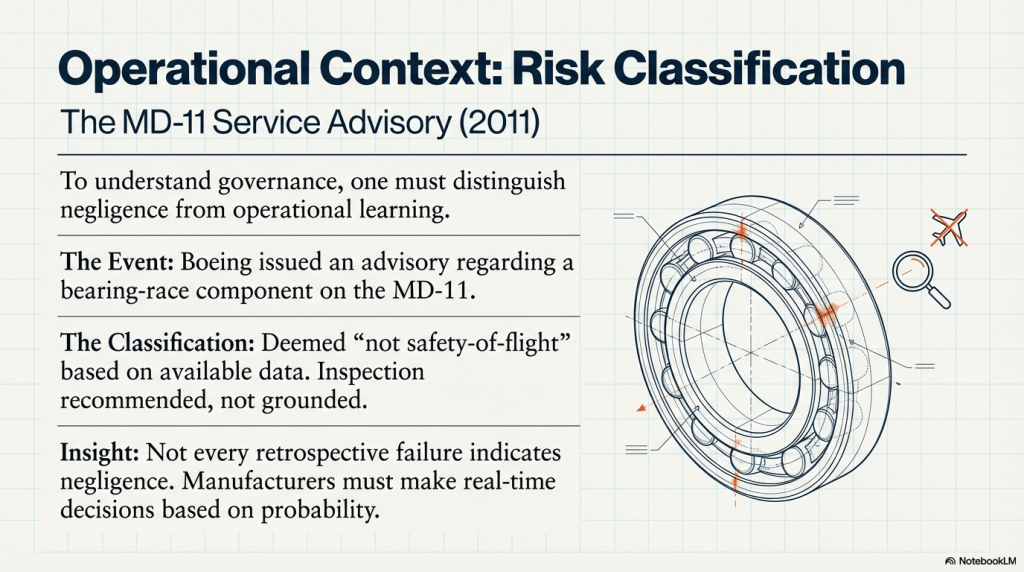
NTSB findings reported by Aviation Week indicate that in 2011 Boeing issued a service advisory concerning a bearing-race component on the MD-11, following several prior failures. The advisory classified the issue as not constituting a safety-of-flight condition at that time, recommending inspection and optional modification.
The NTSB has since referenced this advisory in the context of a later MD-11 accident investigation, noting that the earlier classification reflected the understanding available at the time. No final determination of fault has been issued as of the latest public record (Aviation Week, “Boeing Warned of MD-11 Part Failure Risk, 2011, NTSB Finds”).
This example illustrates risk classification in operational service rather than a finding of negligence.
8. Structural Pattern (Not an Allegation)
Across programmes and decades, a consistent structural pattern is observable in the public record:
| Programme | Dominant Pressure | Governance Outcome |
|---|---|---|
| Concorde | Cold War prestige | No redesign tolerance |
| Boeing SST | Cold War prestige | Programme cancelled |
| 787 | A350 competition | Post-entry redesign |
| 737 MAX | A320neo competition | Legal and regulatory action |
This is an analytical observation, not an attribution of intent.
9. Conclusion
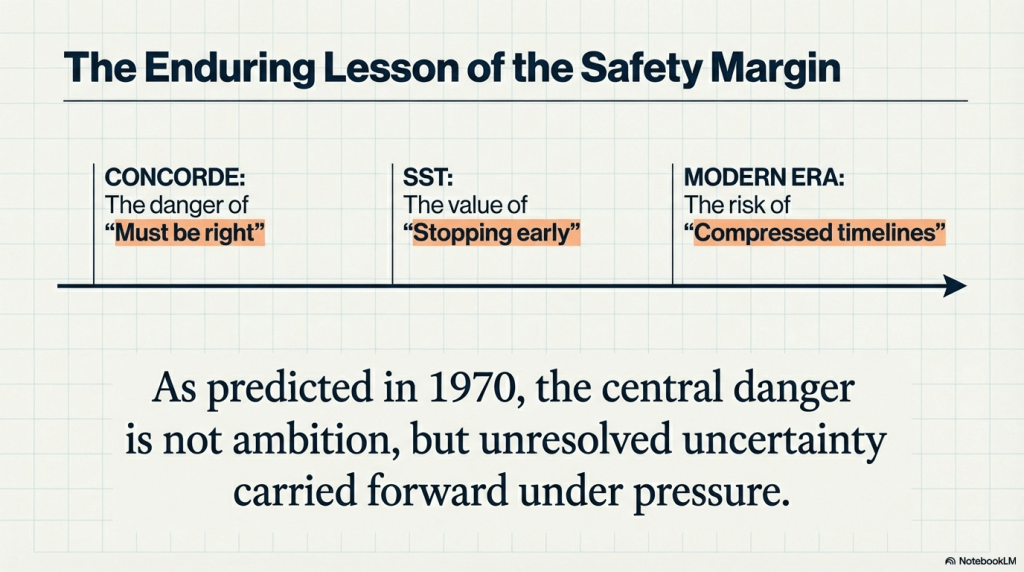
Concorde demonstrates what happens when an aircraft cannot be allowed to be wrong.
The Boeing SST demonstrates what happens when a programme can be stopped early.
The 787 and 737 MAX demonstrate how modern competitive pressure can compress development timelines, requiring strong governance and transparency to prevent risk from migrating into service.
As The Economist warned in 1970, the central danger is not ambition, but unresolved uncertainty carried forward under schedule pressure.
That lesson remains relevant.
Sources (Public, Verifiable)
- The Economist, “What to Do With Concorde?”, May 30 1970
- Congressional Record, Hon. Henry S. Reuss, June 8 1970
- FAA Special Conditions No. 25-359-SC (Boeing 787)
- NTSB Reports: Boeing 787 Battery Investigation (2013)
- FAA Emergency Airworthiness Directive, January 2013
- U.S. DOJ, United States v. The Boeing Company, DPA, Jan 7 2021
- Aviation Week, “Boeing Warned of MD-11 Part Failure Risk, 2011, NTSB Finds”
- NTSB MD-11 Investigation Updates (public releases)
Discover more from Safety Matters Foundation
Subscribe to get the latest posts sent to your email.

Leave a Reply