


Protecting the Circadian Rhythm
The ability of life on Earth to adapt to its surroundings is a significant characteristic.The Earth’s rotation on its axis causes significant daily variations in environmental light and temperature at any given location. Most species have evolved an internal biological clock that anticipates day/night cycles and aids them in optimizing their physiology and behavior in order to adapt to such shifts. The term “circadian,” which derives from the Latin words circa, which means “around,” and dies, which means “day,” refers to this internally produced daily pattern. Circadian rhythms have been preserved throughout evolution for a very long time. They are known to exist in all multicellular creatures, including fungi, plants, insects, rodents, and humans, as well as in unicellular animals like cyanobacteria and protozoans. A self-sustaining 24-hour rhythm generator or oscillator, setting or entraining mechanisms that connect the internal oscillator to external stimuli (referred to as zeitgebers, i.e. timekeepers), such as light, and output mechanisms to enable the timely scheduling of physiological processes make up the fundamental components of a circadian system.
The 2017 Nobel Prize in Physiology or Medicine is awarded to Jeffrey C. Hall, Michael Rosbash and Michael W. Young for their discoveries of molecular mechanisms that control circadian rhythms.
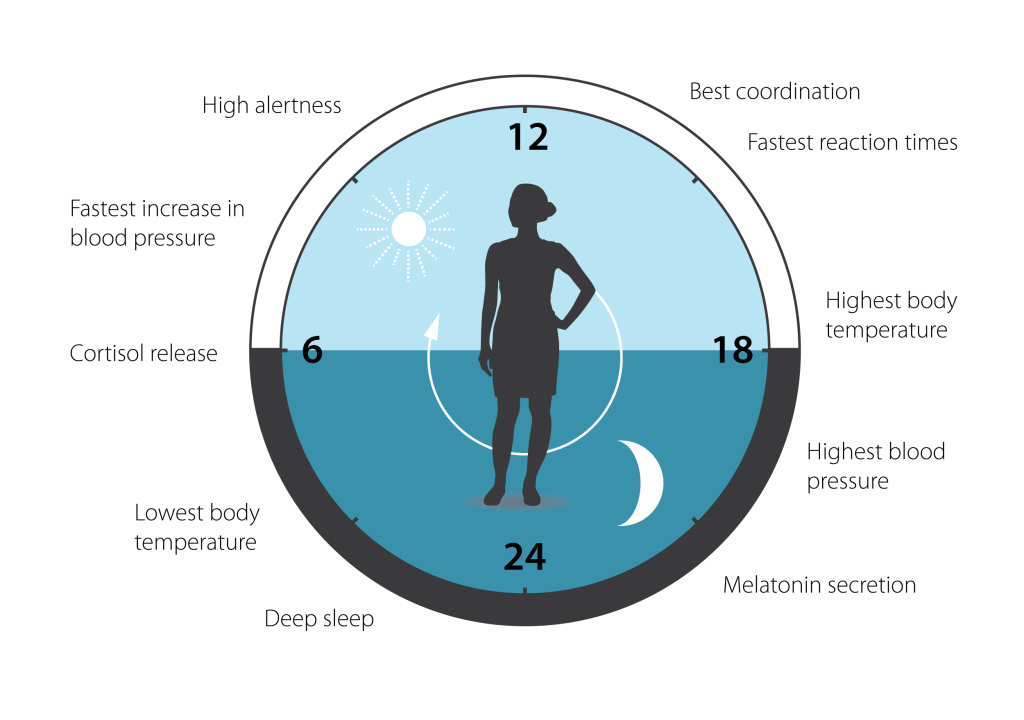
Numerous facets of our physiology are influenced by chronobiology. Circadian clocks, for instance, assist in controlling body temperature, blood pressure, hormone release, sleep patterns, and eating habits. Additionally, molecular clocks are crucial locally in many tissues. Hormones like cortisol and insulin are produced arrhythmically in animal models where clock genes have been removed. Through the regulation of gluconeogenesis, insulin sensitivity, and systemic blood glucose oscillation, clock genes also have a significant impact on metabolism (Panda, 2016). Circadian disruption has been connected to sleep disorders, depression, bipolar illness, cognitive function, memory formation, and various neurological diseases. Sleep is necessary for regular brain function. Rarely, advanced or delayed sleep-wake cycles caused by mutations in the circadian clock genes are the cause of sleep phase disorders . According to studies, there may be an increased risk for many diseases, including cancer, neurological diseases, metabolic disorders, and inflammation, when our lifestyle is chronically out of sync with the rhythm set by our endogenous circadian clock. To enhance human health, techniques in chronobiology and pharmacology are being developed to change the period, phase, or amplitude of circadian clocks.
Sleep Quality or Quantity
Sleep is not uniform. Instead, over the course of the night, your total sleep is made up of several rounds of the sleep cycle, which is composed of four individual stages. In a typical night, a person goes through four to six sleep cycles. Not all sleep cycles are the same length, but on average they last about 90 minutes each.

Stage 1, also called N1, is essentially when a person first falls asleep. This stage normally lasts just one to seven minutes.During N1 sleep, the body has not fully relaxed, though the body and brain activities start to slow with periods of brief movements. There are light changes in brain activity associated with falling asleep in this stage.
During stage 2, or N2, the body enters a more subdued state including a drop in temperature, relaxed muscles, and slowed breathing and heart rate. At the same time, brain waves show a new pattern and eye movement stops. On the whole, brain activity slows, but there are short bursts of activity.
Stage 3 sleep is also known as N3 or deep sleep, and it is harder to wake someone up if they are in this phase. Muscle tone, pulse, and breathing rate decrease in N3 sleep as the body relaxes even further.The brain activity during this period has an identifiable pattern of what are known as delta waves. For this reason, stage 3 may also be called delta sleep or slow-wave sleep (SWS).Experts believe that this stage is critical to restorative sleep, allowing for bodily recovery and growth. It may also bolster the immune system and other key bodily processes. Even though brain activity is reduced, there is evidence that deep sleep contributes to insightful thinking, creativity and memory.
During REM sleep, brain activity picks up, nearing levels seen when you are awake. At the same time, the body experiences atonia, which is a temporary paralysis of the muscles, with two exceptions: the eyes and the muscles that control breathing. Even though the eyes are closed, they can be seen moving quickly, which is how this stage gets its name.
Under normal circumstances, you do not enter a REM sleep stage until you have been asleep for about 90 minutes. As the night goes on, REM stages get longer, especially in the second half of the night. While the first REM stage may last only a few minutes, later stages can last for around an hour. In total, REM stages make up around 25% of sleep in adults.

One may have slept for 8 hours but if the 90 minute cycle is frequently disturbed, the person will get up in the morning tired. Therefore it is important to sleep around the same time every night and for those like shift workers and pilots who can’t, they need sleep deficit recovery strategies. One nights loss of sleep typically is restored with 36 hours of rest. When flight crew undertake successive flight duties, then it is even more imperative that continuous days off are provided to them.
mindFly analysis
Pilot schedules have to be developed with scientific principles. Its is the sleep opportunity that is important and the period that encroaches the window of circadian low must be compensated soon by means of extended rest periods and sleep opportunity. A pilot may sleep less but if the sleep cycle of 90 minutes is not disturbed, the recovery will be faster.
ICAO in Doc 9966 recommends the following scheduling practices:
The perfect schedule for the human body is daytime duties with unrestricted sleep at night. Anything else is a
compromise. There are, however, general scheduling principles based on fatigue science that should be taken into
account when designing a duty schedule:
The circadian body clock does not adapt fully to altered schedules such as rotating shifts or night work.
Some adaptation may occur on slow rotating schedules. There is no clear difference between forwards
versus backwards rotating shift schedules.
Whenever a duty period overlaps an individual’s usual sleep time, it can be expected to restrict sleep.
Examples include early duty start times, late duty end times, and night work.
The more a duty period overlaps an individual’s usual sleep time, the less sleep the individual is likely to
obtain. Working right through the usual night‐time sleep period is the worst‐case scenario.
Night duty also requires working through the time in the circadian body clock cycle when self‐rated fatigue
and mood are worst, and additional effort is required to maintain alertness and performance. Napping
before and during a night duty period is a useful strategy (discussed above in Operational Implication 5:
Napping as a Fatigue Mitigation).
Night duty also forces an individual to sleep later than normal in their circadian body clock cycle, so they
have a limited time to sleep before the circadian alerting signal wakes them up. This can cause restricted
sleep following a night shift. To provide the longest sleep opportunity possible, night shifts should be
scheduled to end as early as possible and individuals need to get to sleep as soon as possible after coming
off duty.
The evening wake maintenance zone occurs in the few hours before usual bedtime. This makes it very
difficult to fall asleep earlier than usual, ahead of an early duty report time. Early report times have been
identified as a cause of restricted sleep in aviation operations.
Across consecutive duty periods that result in restricted sleep, individuals will accumulate a sleep debt and
fatigue‐related impairment will increase.
To recover from a sleep debt, individuals need a minimum of two full nights of sleep in a row. The
frequency of rest periods should be related to the rate of accumulation of sleep debt
Source Sleep Foundation
Discover more from Safety Matters Foundation
Subscribe to get the latest posts sent to your email.
Leave a Reply