


Milan’s 777 tail strike: a cognitive view of a “100-tonne class” takeoff performance error
The Milan story: what happened (as per the preliminary report)
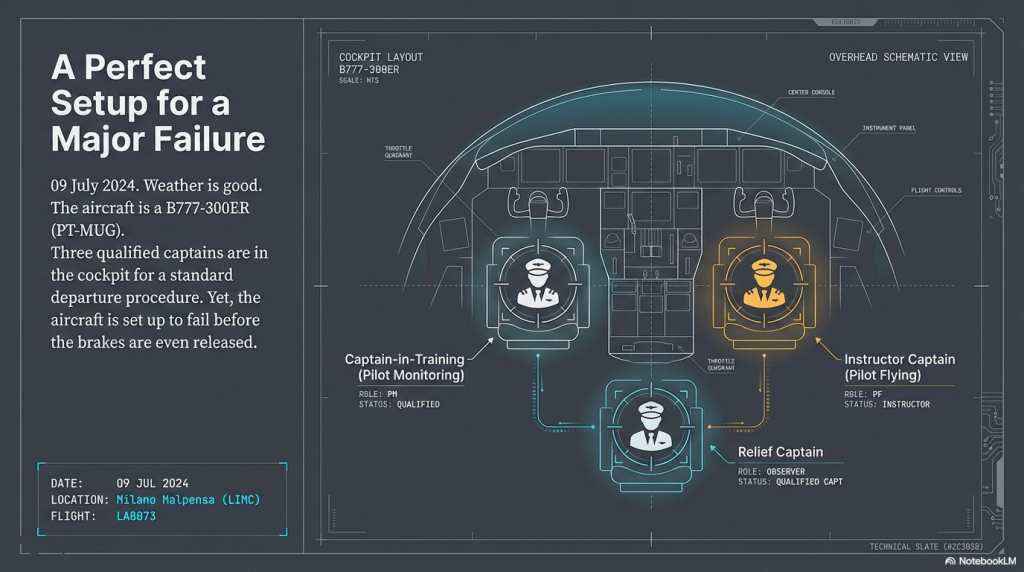
On 09 July 2024, LATAM flight LA8073 (B777-32WER, registration PT-MUG) departed Milano Malpensa (LIMC). The cockpit was in a training configuration: instructor captain in the right seat as PF, captain-in-training in the left seat as PM, and a relief captain on the jump seat, which contributed to a cognitive error in the takeoff process.
The takeoff roll began at 11:25:59. Rotation started at 11:26:37. At 11:26:42, the aircraft’s Tail Strike Indicators activated (recorded IAS 166 kt, pitch 8.2°). An aural tail strike warning was recorded at 11:26:52. ATC also observed the tail strike and warned the crew at 11:27:10.
Runway inspection found a ~723 m “furrow/footprint,” with depths up to 6 cm.
Once airborne, the crew managed the risk: they requested holding at 6000 ft, declared PAN PAN PAN, and later conducted fuel dumping. Dumping ran from 11:51:05 to 12:23:17, with about 72,000 kg dumped in seven holding patterns at 6000 ft and 190 kt IAS. The aircraft landed at 12:36 on RWY 35R, reported GW 249.2 t.
The key facts (from the same preliminary report)

Weights (final load sheet)
- ZFW 219,460 kg
- TOW 328,425 kg
- Fuel in tanks 109,625 kg
Runway
- RWY 35L, “entire available runway,” TORA 3914 m
TAKEOFF REF entries used (FDR / FMS)
- Flaps 5
- Thrust 56°
- V1 145 / VR 149 / V2 156 kt
Operator post-event OTP recalculation (using recorded TOW 328,425 kg; OAT 30°C)
- Flaps 5
- Thrust 38°
- V1 173 / VR 181 / V2 186 kt
Boundary statement (important): This is a preliminary report. It does not yet state what exact wrong input was used or who did what. It does document the mismatch and the recalculation for the recorded weight.
How we infer a “~90–100 tonne low” error (simple plausibility math)
This is training plausibility, not certified performance.
A basic approximation for similar configuration is:

Using the report’s “used” vs “OTP for 328.425 t” values:
- From VR: ((149/181)^2 \times 328.425 \approx 223) t
- From V2: ((156/186)^2 \times 328.425 \approx 231) t
- From V1: ((145/173)^2 \times 328.425 \approx 231) t
So the 145/149/156 set resembles speeds computed for roughly 223–231 t, i.e., about 97–105 t lower than the recorded ~328 t — a “100-tonne class” discrepancy. This inference follows directly from the mismatch documented in the preliminary report.
A further (non-causal) observation: the report’s ZFW ~219.5 t is near this implied band. That does not prove a ZFW/TOW mix-up — it simply shows how a wrong “weight class” could appear internally consistent to a human mind under time pressure.
Past incidents: this is a known family of events
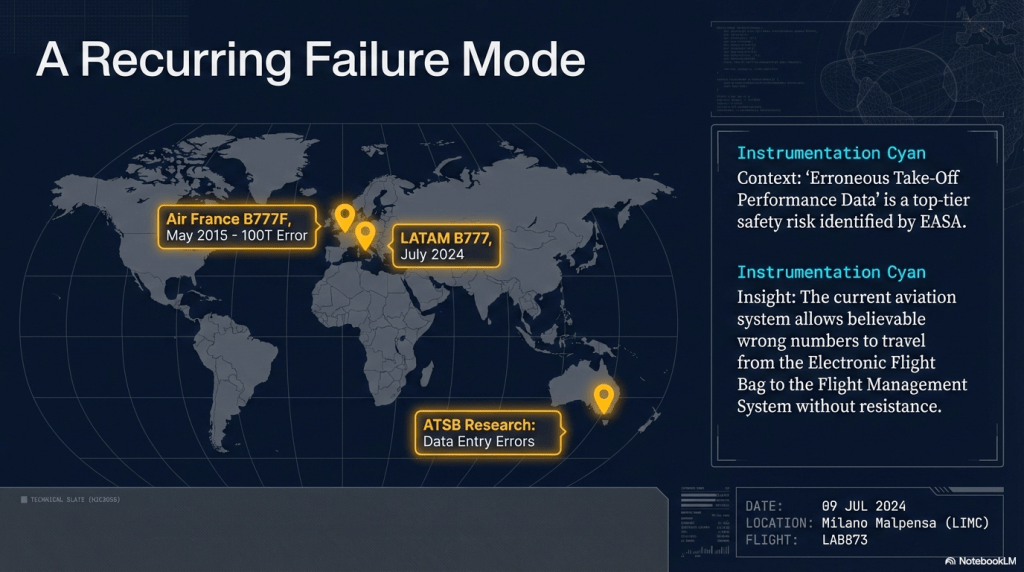
Air France B777F, Paris CDG, 22 May 2015 (BEA)
The BEA describes a serious incident where, during climb, the crew realised they had made a mistake of 100 tonnes in the weight used for takeoff performance calculation. (BEA)
Why this keeps recurring (system context)
The ATSB’s research report Take-off performance calculation and entry errors: A global perspective documents multiple accidents and incidents caused by calculation/entry errors and analyses why they escape checks. (ATSB)
EASA explicitly frames Erroneous Take-Off Performance Data as a safety issue: errors introduced during calculation and entry of takeoff performance parameters into FMS/EFB and related systems. (EASA)
(And yes—Safety Matters has already examined this theme in your earlier work; this Milan case is a contemporary reinforcement of the same cognitive trap.) (Safety Matters Foundation)
The human factors: why this error survives “good crews”
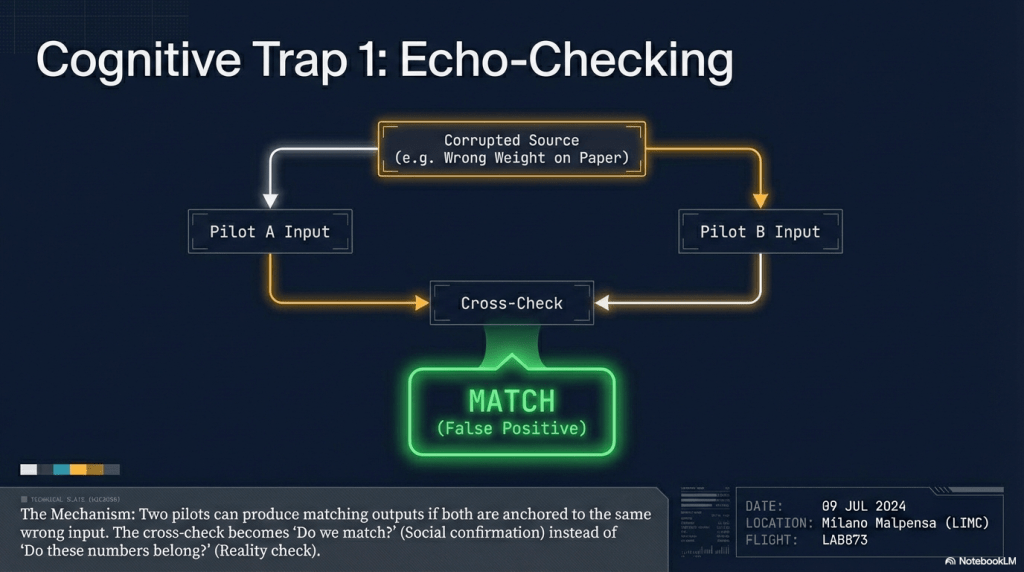
1) Echo-checking replaces independent checking
Two pilots can produce matching outputs if both are anchored to the same wrong input. The check becomes “do we match?” instead of “do these numbers belong to this situation?”
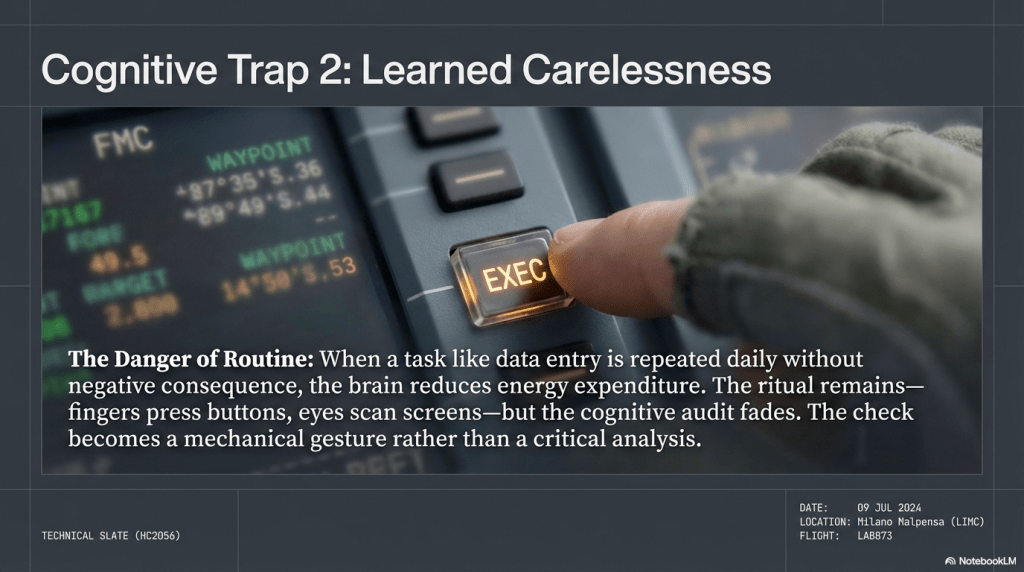
2) Learned carelessness
When a task is repeated every day and rarely bites, the mind naturally reduces effort. The ritual remains — the meaning fades. That’s how gross errors pass through “completed” checks.
3) Training gradients and social friction
Milan mattered because the cockpit had an instructor PF and a trainee PM. That setup is normal — but it increases the need to protect challenge as a duty, not as a personality trait.
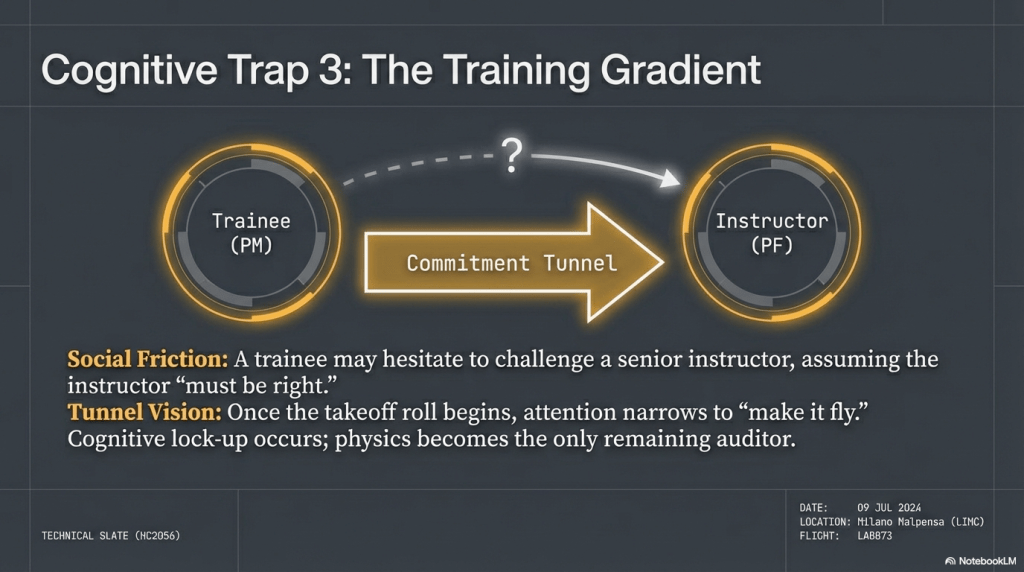
4) Commitment tunnel (cognitive lock-up)
By rotation, time and options shrink. Attention narrows to “make it fly.” If a data integrity error survives to that point, physics is the auditor.
Mindfulness + solutions: turning attention into a safety barrier
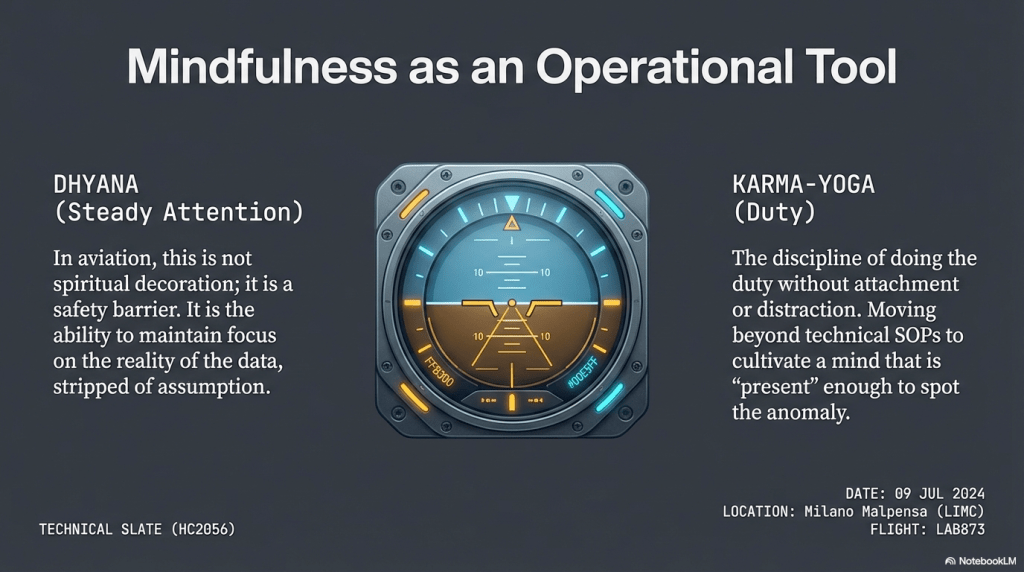
Indian practice is not decoration here. Dhyāna (steady attention) is operationally relevant, and karma-yoga is the discipline of doing the duty without attach
The 2-breath “gross-error trap” (Vipassana, cockpit-real)
Before final takeoff data review (at a calm moment), take two slow breaths and run a five-point scan:
- Weight: “Performance based on TOW ___”
- Runway: length/condition
- Configuration: flap/bleeds/anti-ice as applicable
- Thrust concept: full/reduced/assumed—does it fit the story?
- Speed class: “Do these V-speeds belong to this weight?”
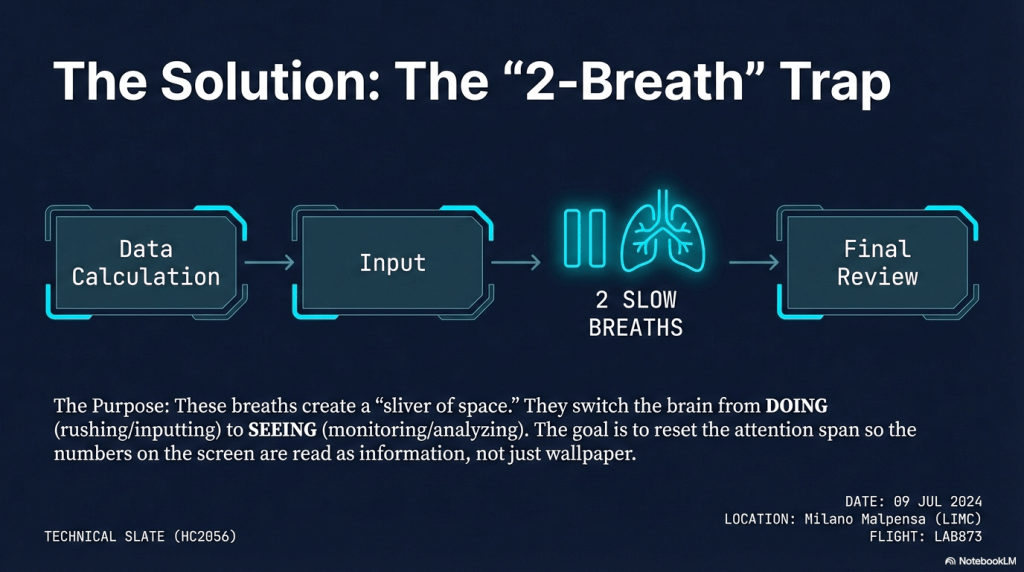
Two breaths create a sliver of space where the mind stops rushing and starts seeing.
Replace “Do we match?” with “Do they belong?”
One scripted line is powerful:
- “These speeds look low/high for this weight—let’s recheck.”
Make speaking up easy (especially from the third seat)
A jump-seat pilot is a safety resource only if culture invites it. Teach one safe sentence:
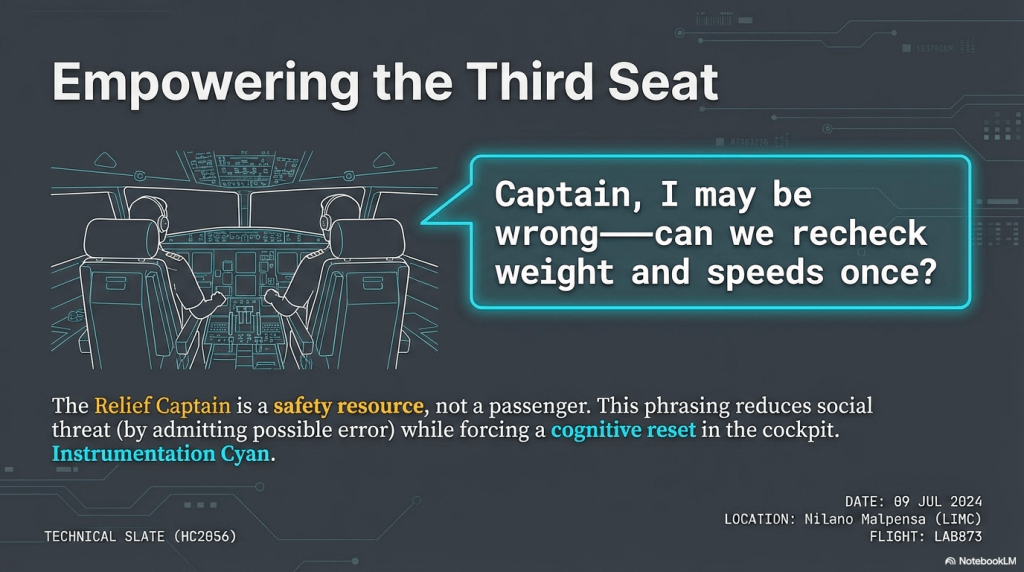
- “Captain, I may be wrong—can we recheck weight and speeds once?”
System direction of travel
EASA’s recent rulemaking work explicitly aims to mitigate the risk using on-board alerting against erroneous takeoff performance parameters and takeoff position errors. (EASA)
Closing
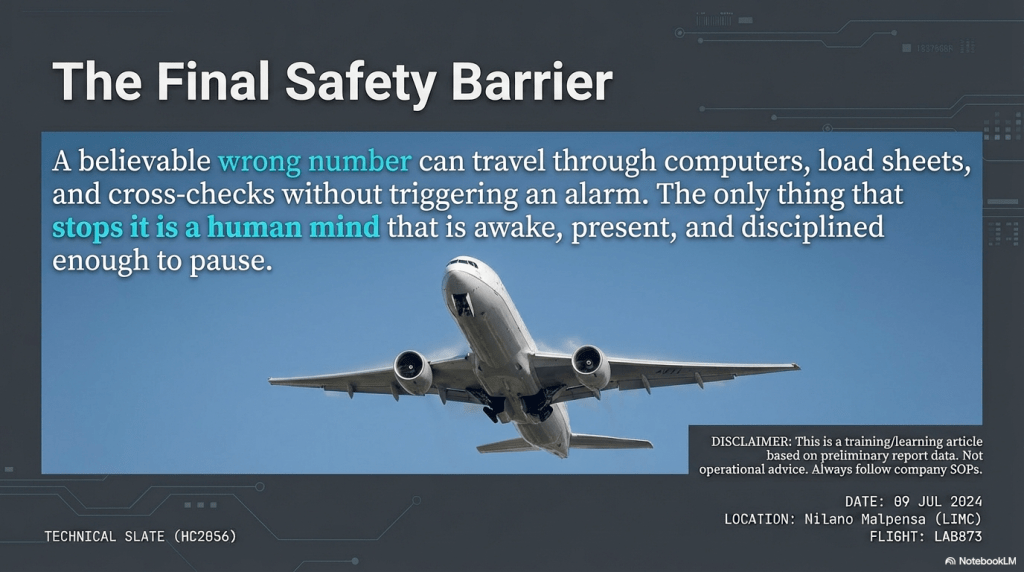
Milan (PT-MUG) reminds us: a believable wrong number can travel through humans and tools, and only reveal itself when margin is gone.
The safety move is earlier: trap the error before it reaches the runway—through plausibility, disciplined challenge, and a two-breath pause that restores attention to duty.
For deeper exploration of this thinking style, see your original mindFly/Safety Matters piece on the Air France 2015 event. (Safety Matters Foundation)
Discover more from Safety Matters Foundation
Subscribe to get the latest posts sent to your email.
Leave a Reply