


Exit Sign to Nowhere: 5 Questions After Chennai Airport’s Fire-Safety Audit

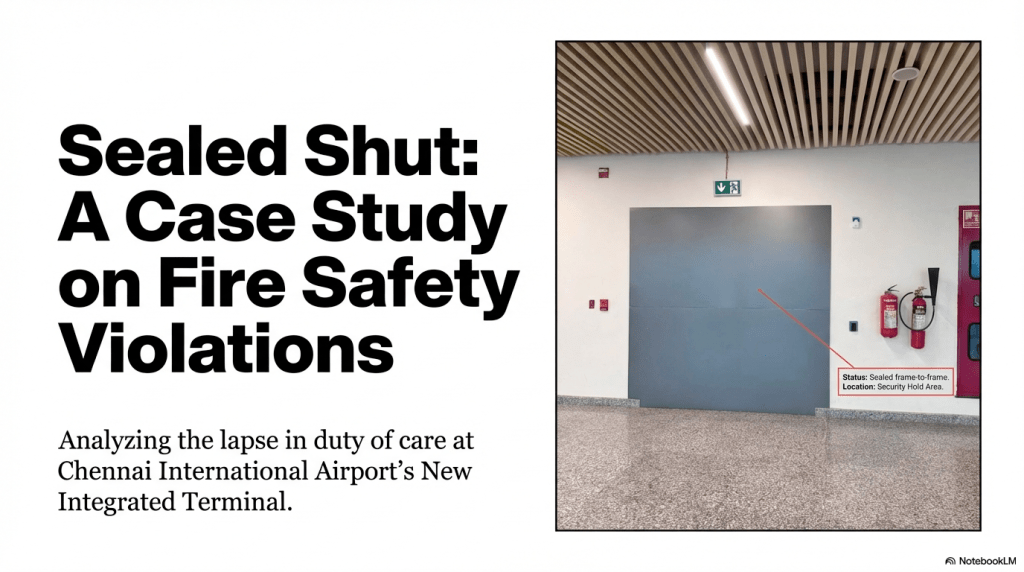
An Exit Sign is a promise. It tells passengers—often strangers in an unfamiliar building—where safety lies when smoke spreads, visibility collapses, and panic becomes contagious. That is why the Chennai Airport episode is not a routine compliance issue. It is a safety-governance failure with potentially catastrophic consequences.
Exit Sign to nowhere: what the public saw

Reports and documented complaints indicate that in a newly commissioned terminal area, Exit Sign boards were installed—but the indicated route led to doors that were effectively sealed/blocked, turning a life-saving cue into a dead end. In any public facility, that is unacceptable. In an airport—high occupancy, mixed demographics, baggage, queues, crowd dynamics—it is dangerous.
A safe building is not defined by how it looks on a walkthrough when everything is normal. It is defined by how quickly people can escape when everything goes wrong.
Exit Sign logic in smoke/fire: why seconds matter

In a fire event, the first enemy is not flame—it is smoke. People do not behave like calm inspectors; they behave like human beings under stress. They follow the most visible cue. They follow the crowd. They follow the Exit Sign.
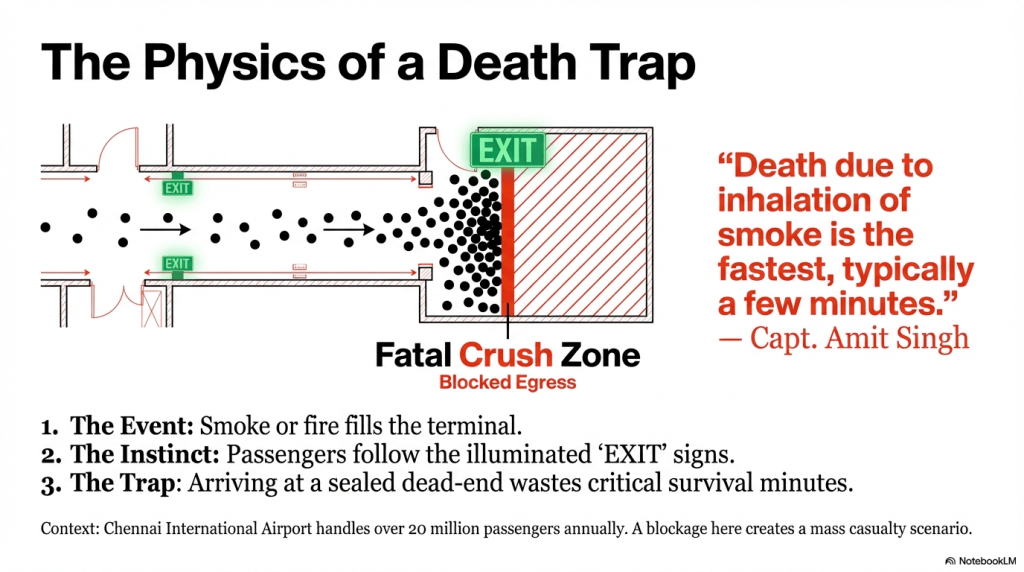
When an Exit Sign leads to a sealed doorway, the risk is not theoretical. It produces three predictable outcomes:
- Delay: people stop, hesitate, turn back.
- Congestion: a bottleneck forms behind them.
- Exposure: time in smoke increases, compounding harm.
This is why fire egress is governed so strictly worldwide: egress failures scale quickly into mass-casualty conditions.
Exit Sign vs sealed door: the human factors risk

The most alarming aspect is not merely a blocked exit—it is the illusion of safety. A visible Exit Sign tells a passenger: “This is the way out.” If the exit is not usable, the building is communicating false information at the worst possible moment.
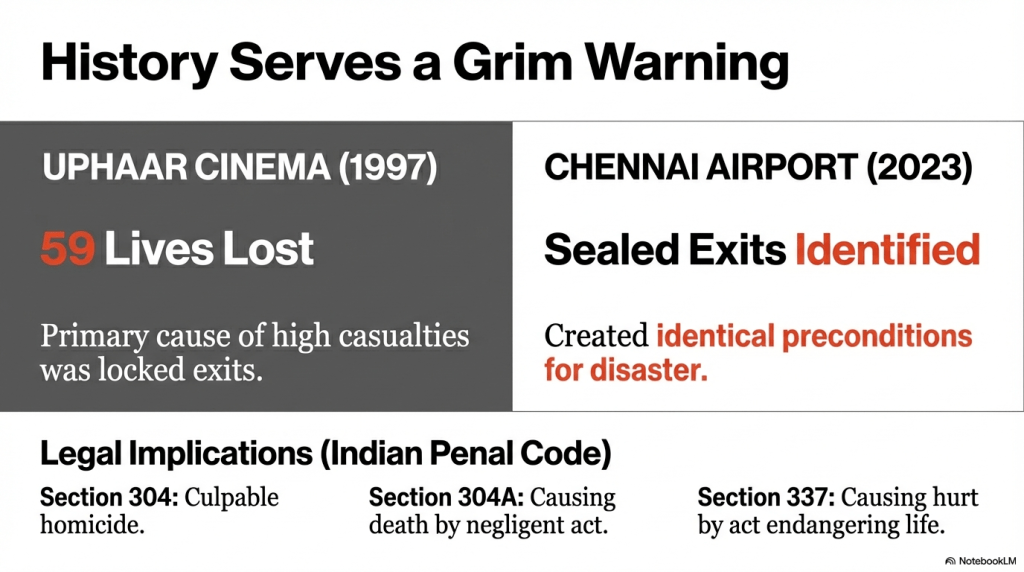
This is where the Uphaar Cinema tragedy remains a warning to India: obstructed/locked exits contributed to loss of life. The point is not to sensationalize; the point is to recognize that the preconditions for tragedy are known—and therefore preventable.
Exit Sign warnings: what was reported in 2023
The governance issue becomes sharper because a formal warning was reportedly raised in 2023 to relevant authorities, with supporting evidence. If a credible warning is submitted and the hazard persists, the failure is no longer a “mistake.” It becomes a question of oversight, accountability, and duty of care.
An Exit Sign problem is not something to “monitor.” It must be corrected immediately—or the affected area should not be operational.
Internal link suggestion (add at least 2):
- Read more investigations in our Safety Culture archive: Read here
- Submit safety observations anonymously via RASE: Read here
Exit Sign upgrades in 2026: audit-driven correction

If corrective steps were triggered later following a fire audit—good. Fixes are welcome. But audit-driven correction is not a substitute for safety culture. The public deserves to know whether hazards were resolved promptly when first flagged—or only after external scrutiny forced action.
This is the core scandal: safety should be preventive, not reactive.
Exit Sign accountability: how did fire clearance happen?

This brings us to the five questions that define the story:
- Clearance: How did the building receive Fire Department clearance if exit routes were unusable in practice?
- Verification: Were functional checks conducted on emergency egress (not just paperwork checks)?
- Responsibility: Which roles owned the decision to accept this risk—design, operations, security, safety?
- Corrective proof: What evidence confirms every indicated exit is now immediately usable from the egress side?
- System reform: What permanent controls ensure this cannot recur—across airports, not just one terminal?
Until these questions are answered transparently, a retrofit story is not a safety story—it is a reputational repair story.
What real reform looks like

A credible response requires more than upgrades. It requires:
- Publishing the audit findings and the corrective action closure proof,
- A clear policy: no exit obstruction, no exceptions,
- Routine independent drills and verification,
- Accountability that is personal (named roles), not generic (vague assurances).
Because an Exit Sign system is not about optics. It is about survivability.
Discover more from Safety Matters Foundation
Subscribe to get the latest posts sent to your email.
Leave a Reply