The Ethiopian Airlines accident on 10th March 2019 was the 2nd B-737 Max accident in 4 months. This created a public outcry about the safety of Boeing 737 around the world and given the fact that Boeing had not been forthcoming in its disclosure of the new software, MCAS.All countries flying the B-737 had to ground the aircrafts flying in their airspace and the last but not the least the FAA very reluctantly followed suit. Every one tried to draw similarities between the accidents stating that the flight profile was similar and that both the aircrafts nose dived shortly after takeoff. For the first time in the history of aviation that the entire fleet around the world had been grounded on the basis of public perception and without any evidence. This also showed the lack of trust that the regulators of all the countries had with FAA and Boeing.
...#pilot monitoring
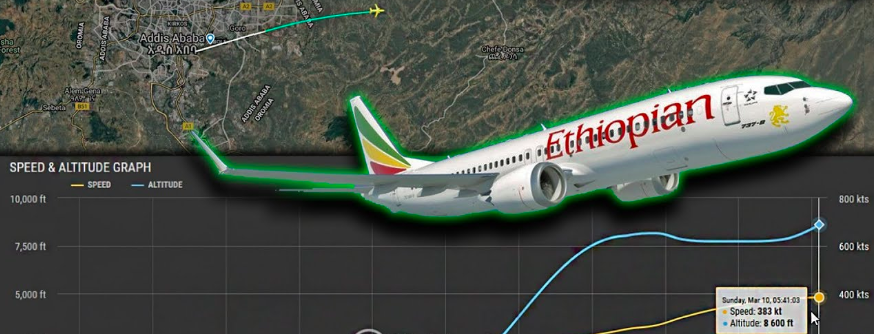
ET302 takeoff roll could have answers to the cause of accident: mindFly
In my opinion the primary cause of the ET302 accident lies in the take off roll , the final nose dive could have been caused due to structural failure of the elevator and in an extremely improbable case, the infamous MCAS would have had a role to play. All aircrafts are loaded with passengers, cargo and fuel and maintained within limits of the centre of gravity so that a safe takeoff, airborne segment and landing is carried out. Based on the weight and balance of the aircraft and the airport/runway and environmental conditions, the flight crew calculate how fast the aircraft needs to roll on the runway (speed) and how much engine thrust needs to be generated in order to accelerate with the given mass and other conditions to allow the wings to generate lift from the air mass flowing over the wings. All these parameters have to keep the aircraft takeoff roll within the runway length and after getting airborne keep clear of the obstacles like hills, buildings etc. around the airport.
...Behaviour, ABC
Antecedents: What Happened Before the Behavior?Behavior: What Is the Actual Behavior?Consequences of Behaviour: What Happens...
Prevent inadvertent slide deployment by learning from Japanese Bullet Train Drivers: mindFly
Pointing and calling Flight Safety Australia In 2014, the International Air Transportation Association estimated that inadvertent slide deployment costs the airline industry more than $20 million each year. What can aviation learn from the bullet train driver. With the horrible exception of the Amagasaki crash of 2005, which killed 107 people, Japanese railways are notably safe, with one passenger death per 51.4 billion passenger kilometres. The high-speed Shinkansen network, which is now six lines with trains running at up to 320 km/h (170 kt), has carried more than 10 billion passengers without a single passenger death from derailment or collision. In 1994, the Japanese Railway Technical Research Institute assessed pointing and calling in an experiment that asked volunteers to complete a simple, but variable, task. When no special steps were taken to prevent errors, the volunteers made 2.38 errors per 100 actions. Calling or pointing cut this error rate significantly. But the greatest reduction in error to 0.38 errors per 100 actions happened when the volunteers both pointed and called their actions. This combination reduced mistakes by almost 85 per cent.
...


