Sapiens: A brief history of man kind by Yuvak Noah Harari About 13.5 billion years ago, matter, energy, time and space came into being what is...

Gurukul for Safety


Sapiens: A brief history of man kind by Yuvak Noah Harari About 13.5 billion years ago, matter, energy, time and space came into being what is...

A trainee checks-in, uses her/his retina or facial scan to enter the training session. From day one they are assisted by virtual trainers and...
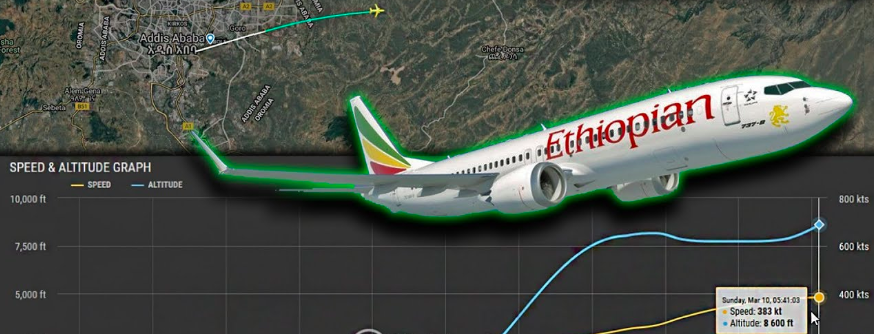
ET 302 took off from Addis Ababa, the capital of Ethiopia on 10th March 2019 and 06 minutes into the flight met with an accident. The aircraft was the Boeing's latest addition to the B-737 series, the B-737 8Max. The infamous MCAS(software) was to have played a role in the accident and nations all over the world, fearing the safety of the traveling passengers, banned the aircraft flying in their airspace. It soon became a world wide ban, thus grounding the MAX fleet. I will not critique on the crew action or inaction because their behaviour will need to be analysed in great depth after more details are released. Download the Preliminary investigation report ET302 10 Mar 2019 Boeing 737 has had rudder design issues in the 1990's when there were a series of accidents involving United, US Air and Silk Air. Read my blog on A question of Safety or Ethics:Boeing 737 mindFly . Boeing was quick to respond to it and wanted the editors to take the blog down but the evidence was over bearing and the blog survived.
...
Every flight crew involved in an accident/incident is flying the aircraft due to the fact that they have undergone the necessary training and have demonstrated their proficiency/competency. Since the flight crew is the last line of defense and as Prof. Patrick Hudson puts it is the first person at the scene of the accident/incident. The question that naturally arises is, why did the crew not prevent the accident/incident if they were adequately trained and had demonstrated their ability to fly safely? In his 1931 book "Industrial Accident Prevention, A Scientific Approach", Herbert W Heinrich put forward the following concept that became known as Heinrich's Law: in a workplace, for every accident that causes a major injury, there are 29 accidents that cause minor injuries and 300 accidents that cause no injuries. This is commonly depicted as a pyramid (in this case with the number of minor incidents shown as 30 for simplicity):
...
All aircraft, engines, and propellers must meet and maintain minimum standards for design, material, construction, quality of work and performance before they can be produced and operated. The International Civil Aviation Organization (ICAO) requires each contracting state to adopt airworthiness standards for the design and performance of aeronautical products. States must ensure that aircraft, including components (engines and propellers), meet these airworthiness standards. ICAO allows states to accept a product approved by another ICAO contracting state without further showing, or to validate another country’s determination that a product meets airworthiness standards.
...
Why does fear set in when our plan fails? Had we acted in advance, there wouldn't have been panic.

In my opinion the primary cause of the ET302 accident lies in the take off roll , the final nose dive could have been caused due to structural failure of the elevator and in an extremely improbable case, the infamous MCAS would have had a role to play. All aircrafts are loaded with passengers, cargo and fuel and maintained within limits of the centre of gravity so that a safe takeoff, airborne segment and landing is carried out. Based on the weight and balance of the aircraft and the airport/runway and environmental conditions, the flight crew calculate how fast the aircraft needs to roll on the runway (speed) and how much engine thrust needs to be generated in order to accelerate with the given mass and other conditions to allow the wings to generate lift from the air mass flowing over the wings. All these parameters have to keep the aircraft takeoff roll within the runway length and after getting airborne keep clear of the obstacles like hills, buildings etc. around the airport.
...
