


When the influential can’t defend themselves in aircraft accident investigations

A VIP was killed in the King Air C-90 crash on 30 September 2001—and that single fact is enough to make any serious investigator pay attention.
Not because VIP accidents are “special,” but because they often sit at a dangerous intersection: public scrutiny, institutional pressure, and a strong temptation to settle on a convenient story. And this investigation is particularly intriguing for a second reason: there are very few cases where an aircraft, while cruising, appears to simply fall from the sky. When that happens, the range of credible explanations narrows—and the evidence should, in theory, point firmly in one direction.
In this case, it doesn’t.
What makes the investigation peculiar is not only that eight people perished, but that the final report cannot conclusively determine a probable cause. Instead, it records details that are intriguing—some inconsistent—and some that raise an uncomfortable possibility: that parts of the “facts” may have been managed, shaped, or even fabricated.
That is why this case continues to pull investigators in. Because when a report cannot confidently say what caused a rare, high-consequence event—yet still presents a narrative—an investigator immediately wonders: What is missing? What was softened? What was never allowed to surface?
There is an urgent need for high-calibre investigation reports that reveal the truth and break the long-standing habit—seen too often in safety systems—of manipulating facts and preaching comforting lies.
And once you read the report carefully, you realise there is more here than meets the eye. The investigator is left with deep interest and many unanswered questions—but three basic ones rise to the surface:
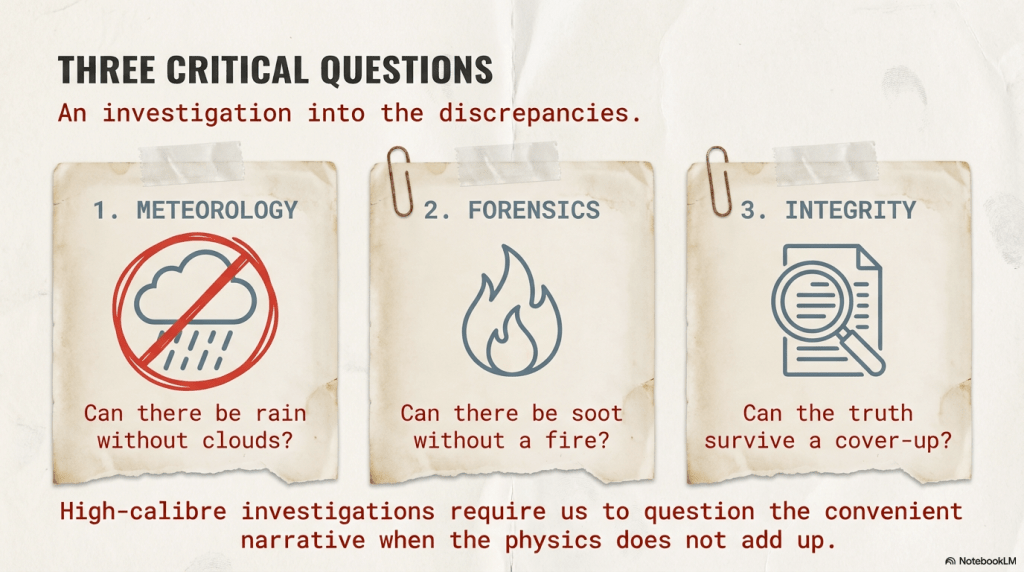
In an investigation like this, every detail matters. Weather must be examined with discipline, not assumptions. Maintenance history must be treated as evidence, not inconvenience. Crew decisions must be analysed in context—information available at the time, workload, pressure—without the arrogance of hindsight. Each element plays a crucial role in assembling the only outcome that truly matters in safety work: an honest narrative that prevents recurrence.
Human Factors for investigators begins here.
Aircraft fires are rare, and in-flight fires are even rarer. In most accidents, fire is caused due to impact. Even if the accident is survivable from the human body’s tolerance of G forces, casualties are on account of the post-impact fire.
Fire causes burn injuries, but the most lethal killer is carbon monoxide. The new-age aircraft cabin has a lot of plastics to reduce weight and improve fuel efficiency. The flashpoint of these materials is much higher, but if they catch fire, they are 50 times more lethal than CO since they produce Cyanide gas and can kill within 30 seconds.
The Station club fire in Rhode Island, USA killed 100 and injured 230. The death rate was high due to toxic gases rather than fire burns.
Interpreting the weather data
The final report states that the weather, as per witnesses on the ground, was heavy rains, low clouds, and strong winds which corroborate the intensity of bad weather.The report quotes Meteoe satellite pictures made available by the India Meteorology Department. The report further states that the picture also indicates that the system has moved in a South Westerly direction, thus lying almost across the track unlike earlier when the track was crossing the SW edge of the system.
However, as interpreted by the Met. Deptt. and given in their report, Mainpuri, the scene of the accident, was just inside the Southern boundary of the convective cloud mass. The top of the system, as per the analysis, is approximately 45,000 ft., clearly indicating a very active development. The satellite picture also indicates that the said aircraft had managed to negotiate a major portion of the weather and would have shortly been out of it into the clear when it crashed.
The report gives specifics of the prevailing meteorological situation. ‘The area was heavily covered with thick rain clouds associated with thunderstorms and lightning. It was raining heavily at Mainpuri and the surface wind was from the West to the East. As per villagers, they had heard the aircraft sound amidst rain, thunder, and strong wind.
Moreover, the investigation into the accident highlights the importance of thorough training for all personnel involved in aircraft operations. The human element cannot be overlooked in any investigation, as human error is often a significant contributing factor in aviation incidents.
Understanding the dynamics of the investigation process can also lead to improvements in aviation safety. It is essential to learn from past mistakes documented in previous investigations to prevent future tragedies.
Eumetsat was contacted, and high-resolution satellite pictures from the archives were procured under a license to publish in a report form. The aircraft track given in the final report was superimposed on the high-resolution images. The basic analysis contradicts the findings of the investigation report.


Figure 1. Eumetsat Infra-Red Satellite images time 0800 UTC(accident time 0801UTC) 30th Sept 2001
Infrared images represent the infrared radiation emitted by the clouds or by the earth’s surface. They are actually measurements of temperature. For an infrared picture, warmer objects appear darker than colder objects. Cloud-free areas will typically be dark, but also very low clouds and fog may appear dark. Most other clouds are bright. High-level clouds are brighter than lower-level clouds.

In conclusion, the investigation into the King Air C-90 accident not only seeks to uncover what went wrong but also aims to prevent similar occurrences in the future through diligent analysis and reporting.
Furthermore, the investigation needs to highlight the potential for technology to aid in future flight safety, showcasing how advancements can impact the outcome of investigations.


Figure 2
Where were the clouds?
As the investigation unfolds, it is essential to consider the broader implications of the findings. Each investigation contributes to the collective knowledge that enhances safety protocols and informs regulatory policies in aviation.
This incident serves as a reminder that investigations must be conducted with the highest level of integrity and transparency to ensure public trust in the safety of air travel.
- There were no rain bearing clouds in the vicinity of the accident site. The report contradicts itself at the end where the prevailing weather of Mainpuri is given shows ‘NO WEATHER’ (Figure 2). As per the report, the sky is clear at 0830 IST (0300 UTC) and Cumulus(fluffy clouds not associated with rain) ) clouds at 1730 IST (1200 IST). There is no indication of thunderstorm or rain as has been stated in the final report.
- The high resolution images obtained from Eumetsat for the period of the crash show that there were probably low level clouds but not rain bearing clouds and thus they would not be associated with thunder.
- Archive Data obtained from meteoblue confirms that there was NO precipitation at Bhogaon (accident site) on the 30th Sept 2001 at the time of the accident.
- The metroblue archive data also confirms that there were only low level clouds till about 5,000 feet which were well below the aircraft’s cruising level of 15,000 feet.
The accident final report states that it was raining heavily at Mainpuri and the surface wind was from the West to East.However, the archive data from meteoblue shows the winds in the region and at the accident site (Bhogaon) to be easterly (Figure 3).
The final report states that there was a heavy thunderstorm and rain associated with strong winds. The cause of the accident is also attributed to tall clouds. However, the archive data sources through meteoblue show that during the period of the accident there was no precipitation in the region.

What was the Wind Direction?
The accident final report states that it was raining heavily at Mainpuri and the surface wind was from the West to East. However, the archive data from meteoblue shows the winds in the region and at the accident site (Bhogaon) to be easterly (Figure 3).
The upper winds at various levels were sourced through meteoblue. Winds from near ground level till 9800 feet (700Mb) were easterly to southeasterly. Upper-level winds from 18,000 feet to 34,000 feet were recorded as southwesterly. This is in contrast to the final report which claims that the winds were westerly. As a general rule, winds in the monsoon and towards the end of the monsoon are generally easterly.


Figure 4

The final report states that the aircraft finally came to rest in a north-north western direction. The winds, as per the report, were from the west direction at 4 km/hr.Interestingly, the accident was the only place in the region where the winds were westerly, while other places in the region were experiencing easterly winds typical of monsoon, relating to the monsoon period of September end.

What does this mean, and what was the motivation to write incorrect winds in the final report?The SOOT marks on the aircraft where it finally rested indicate the flow of fire & SOOT over the aircraft body.If the aircraft was engulfed by post-impact fire, only a westerly wind would have swept the SOOT over the body, while an easterly wind would have kept the flame and SOOT away from the body.
The fact is that the winds in the entire region were from the Easterly direction, as seen in Figure 4 of the archived meteorological data.Secondly, a 4 kmph wind would have kept the flame straight, thereby preventing the SOOT deposit over the body.

The figure representing 1.1m/s is equivalent to 2kts or 4kmph of prevailing winds.
I

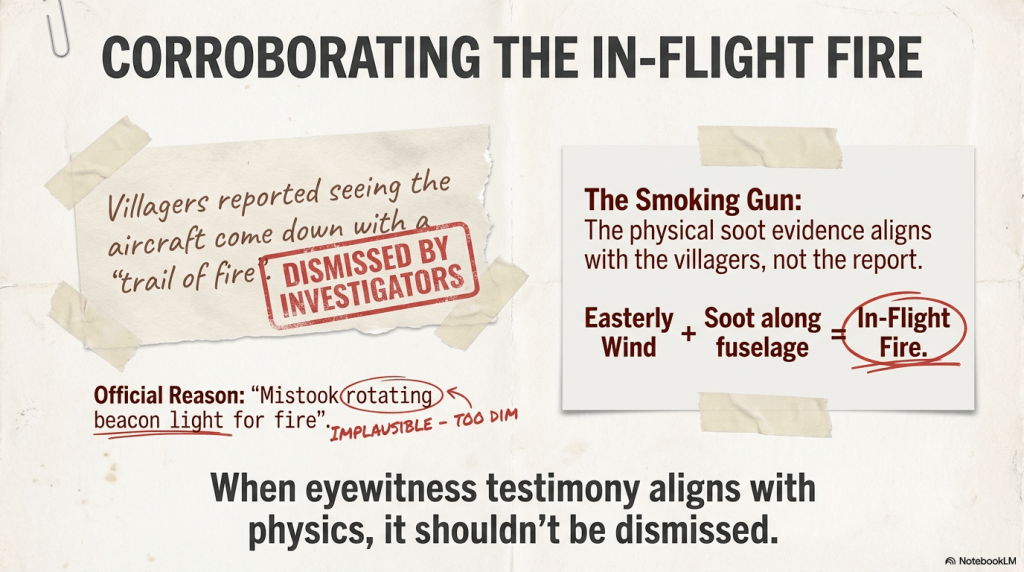
t is therefore likely that there was an inflight fire that caused the SOOT to flow over the body of the aircraft (Figure 5) due to the flow of wind as the aircraft moves through it.The eyewitness reported the aircraft coming down with a trail of fire. However, this theory was dismissed by the investigators who presumably had a motivated interest in pinning the blame on the pilots. The report concluded that the RED beacon light may have caused the glow and impression of fire on board.
There is no SOOT without a fire.
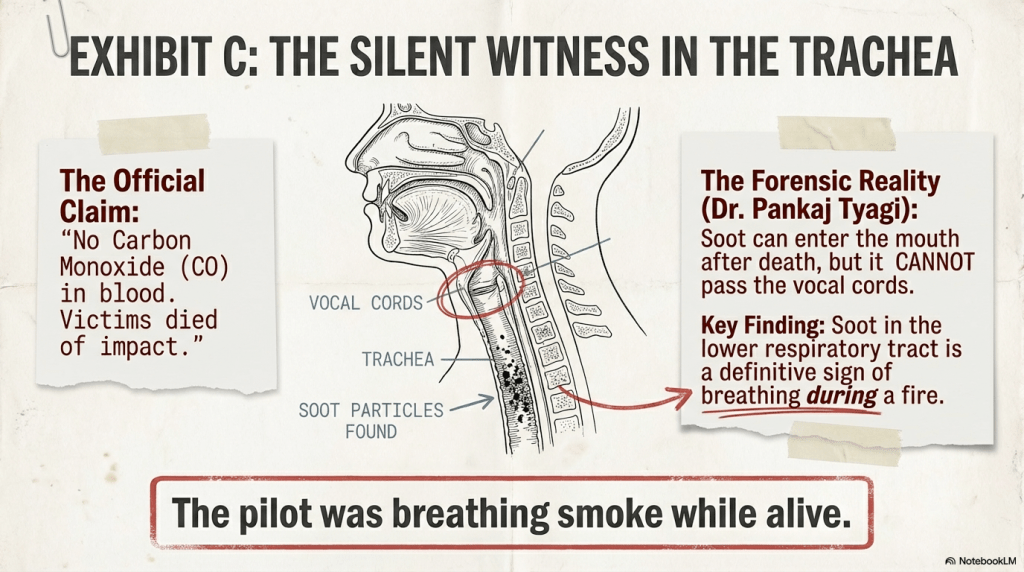
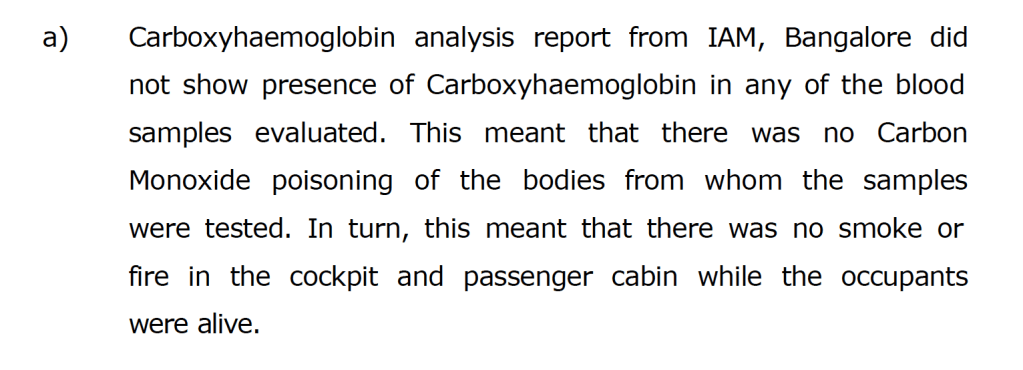
The pathological report of the occupants revealed that all occupants, i.e. the two flight crew and all six passengers received fatal injuries, including burns.The flight crew, Captain and Co-pilot, were found fastened respectively in the left and right seats in the cockpit.As per the final report, there was no presence of Carbon Monoxide in the blood samples of the victims.

As well as the inhalation of carbon monoxide, victims in a fire usually breathe in carbon particles present in the sooty smoke. Once again, this is more pronounced in a building fire than in a vehicle blaze, though there are many exceptions. The combustion of timber floors, roofs, furniture, and the fabric of furnishings and carpets produces large volumes of dense black smoke. Aircraft fires are no different.
The question about the presence of SOOT in the lower respiratory system without fire and other related queries on medical pathology were posed to Dr.Pankaj Tyagi, Managing Director, Space Aviation Medicine & Engineering Creative Solutions Plus (SEMACSPlus).He has served in the Indian Airforce and is a renowned aviation medical specialist, having held the ranks of Air Vice Marshal, Commandant at the Institution of Aviation Medicine. Following is a brief summary of replies received from Dr. Pankaj Tyagi.
Dr. Pankaj confirmed that the severe decelerative forces dissipating in different axes, with resultant force in different directions of each body being different, and its impact force on vital organs of the body, mainly head and brain, would have caused instantaneous death.
The whiplash injuries on the skull resulting in explosive fractures and damage to the brain without helmet protection were the main cause for the brain to be exposed for most of the occupants.
When asked about smoke inhalation before death, Dr. Pankaj replied that it could not be ascertained with certainty as it depends on the collection and preservation of appropriate samples like tissues beyond the trachea, lungs, etc. The test which confirms the inhalation of smoke is called a CarboHomoglobin test (COHb). The result of the test did not show the presence of Carbon Monoxide in the blood, yet only the Captain’s lower respiratory system, the trachea showed evidence of SOOT, which is a byproduct of a fire.
By doing so, we honour those affected by past accidents and work tirelessly to prevent future tragedies within the skies.
Finally, each investigation into an aviation accident must be treated with the utmost seriousness and dedication to uncovering the truth.
The collaborative efforts in investigations can lead to significant safety advancements that benefit all stakeholders within aviation.
Ultimately, this investigation serves as a vital tool for change, guiding the aviation industry toward safer skies.
The goal remains clear: to ensure safety for every passenger and crew member on board during all flights.
In conclusion, this investigation underscores the importance of vigilance and thoroughness in all future aviation inquiries.
Thus, as we reflect on the investigation of the King Air C-90 crash, let us remember the lessons learned and strive for continual improvement in aviation safety.
Therefore, the commitment to thorough investigations must be unwavering, as they are crucial in shaping aviation safety and addressing potential hazards swiftly and effectively.
Each investigation contributes to a collective understanding that ultimately aims to safeguard future generations of air travellers.
It is through rigorous investigation that we can ensure the integrity of the aviation sector and uphold the highest safety standards.
Let this investigation serve as a catalyst for change, driving forward the standards of safety that protect lives.
In summary, the investigation into the King Air C-90 crash not only seeks answers but also aims to foster a culture of safety and learning within the aviation community.
Moreover, the process of investigation itself should continuously evolve, reflecting advances in technology and methodologies to improve the reliability of findings.
Every investigation holds the potential to enhance safety measures and prevent future tragedies, a paramount goal for all in the aviation industry.
As we move forward, the commitment to excellence in aviation investigations must remain steadfast, ensuring that all findings contribute positively to the field.
Ultimately, the importance of thorough investigations cannot be overstated, as they play a vital role in shaping the future of aviation safety.
The insights gained from such investigations are invaluable in creating a safer flying environment, thus ensuring that the lessons learned from every investigation are not forgotten.
By enhancing the investigation process and ensuring that each aspect is meticulously examined, we can work towards making air travel safer for everyone.
The question which arises is with respect to the COHb analysis and if the samples were collected & analysed correctly. Dr. Pankaj replied that the correct procedure for collection and analysis of pathological samples was not followed as a lot of time had been spent before taking samples.This is to recap that the accident occurred in the forenoon of 30th Sept 2001 and the bodies were sent for the conduct of post-mortem post 0700, the next morning.
The aircraft cabin contains a lot of plastics which emit Hydrogen Cyanide, which is much more lethal than Carbon Monoxide.The test for the presence of Hydrogen Cyanide and other volatiles was not carried out during the post-mortem examination of the deceased.
The presence of cyanide in blood specimens of the victims of the 1970 Capitol International Airways DC-8 post-crash fire accident at Anchorage, AK necessitated research into the origin of cyanide in aircraft fires. Because aircraft materials do contain carbon and nitrogen, they generate CO and HCN upon burning, and air passengers could be exposed to these gases by inhaling smoke in the unfortunate event of in-flight or post-crash fires.
The actual degree of toxicity produced by smoke can be established in the victims of fire by the analysis of their blood for CO as COHb and HCN as CN. Various analytical methods for the blood analysis of COHb and CN.
Sample life
Although COHb below 5% is considered normal, healthy individuals may accumulate up to 10% COHb by inhaling CO-contaminated air.COHb concentrations as high as 17% have been documented in heavy smokers.An approximately 20% decrease in COHb levels as a function of time has been reported in postmortem blood samples collected from fire victims.Therefore, COHb analytical values may not reflect the true levels of this species at the time of death, but they may represent approximate values at death.
Although COHb below 5% is considered normal, healthy individuals may accumulate up to 10% COHb by inhaling CO-contaminated air (75,76). COHb concentrations as high as 17% have been documented in heavy smokers (77). An approximately 20% decrease in COHb levels as a function of time has been reported in postmortem blood samples collected from fire victims (59). Therefore, COHb analytical values may not reflect the true levels of this species at the time of death, but they may represent approximate values at death.

Blood Cyanide (CN) concentrations are also strongly affected by the postmortem interval, decreasing by approximately 50% per day in a cadaver. CN in the blood can be in the HCN form.In its protonated form, CN as HCN could be easily diffused through the body and released into the surrounding atmosphere, thereby reducing CN levels.
Fire-related Accidents
Swiss Air accident near Peggy’s Cove, Canada 1998, Galaxy flight 203 in 1985, British Air Tours B737 1985, Saudi Airlines flight SV163 in 1980 has been involved in fire-related accidents and death of crew and passengers.
Swiss Air accident near Peggy’s Cove, Canada 1998, Galaxy flight 203 in 1985, British Air Tours B737 1985, Saudi Airlines flight SV163 in 1980 has been involved in fire-related accidents and death of crew and passengers.
Blood COHb and CN were elevated in most of the victims. Volatile substances were also detected in the blood of the victims and carbon particles in the trachea and bronchi.
Source: Aviation Combustion Toxicology: An Overview Arvind K. Chaturvedi
Bioaeronautical Sciences Research Laboratory (AAM-610), Aerospace Medical Research Division, Civil Aerospace Medical Institute, Federal Aviation Administration, U.S. Department of Transportation.
The Carbon monoxide levels in the blood are a valuable indicator that the victim was alive after the fire began, but the fact that a body in a fire does NOT have carboxyhemoglobin levels in the blood does NOT mean that they must have been dead before the fire began.

Can there be SOOT without FIRE?
As well as the inhalation of carbon monoxide, victims in a fire usually breathe in carbon particles present in sooty smoke.As a marker of antemortem inhalation, as useful as CO.Soot particles may enter the open mouth of a corpse, stain the tongue and pharynx, and may even reach the glottis.No significant amount can pass the vocal cords and enter the trachea after death, however, so carbon in the lower respiratory tract is a certain indicator of breathing during the fire.It is illogical and sometimes legally dangerous to draw the unwarranted inference that such a victim must have been dead before the fire began, however common the generalization may be.
As well as the inhalation of carbon monoxide, victims in a fire usually breathe in carbon particles present in sooty smoke. As a marker of antemortem inhalation, as useful as CO. Soot particles may enter the open mouth of a corpse, stain the tongue and pharynx, and may even reach the glottis. No significant amount can pass the vocal cords and enter the trachea after death, however, so carbon in the lower respiratory tract is a certain indicator of breathing during the fire. It is illogical and sometimes legally dangerous to draw the unwarranted inference that such a victim must have been dead before the fire began, however common the generalization may be.
Source: Forensic Pathology Bernard Knight, Prof. of Forensic pathology, Wales Institute of Forensic Medicine.
Various studies have concluded that the presence of soot particles in the lower airway, like the larynx below the vocal cord, trachea, main bronchus, and both bronchi, is a reliable indicator for the antemortem nature of death due to flame burns, especially in charred and decomposed bodies. The absence of soot, however, does not necessarily mean that the individual was dead prior to the start of the fire.
Source: A Savior Selva Suresh, S Sivakkumar, A study on the presence of soot particles in fatal flame burns cases in Tamil Nadu. MedPulse – International Medical Journal. July 2016
Human Factors for Investigators

Accident investigation aims to determine the root cause(s) and prevent any similar accident.However, during the process of investigation, human bias creeps in, and in a number of investigations, the purpose is lost or dumped midway for vested interests.
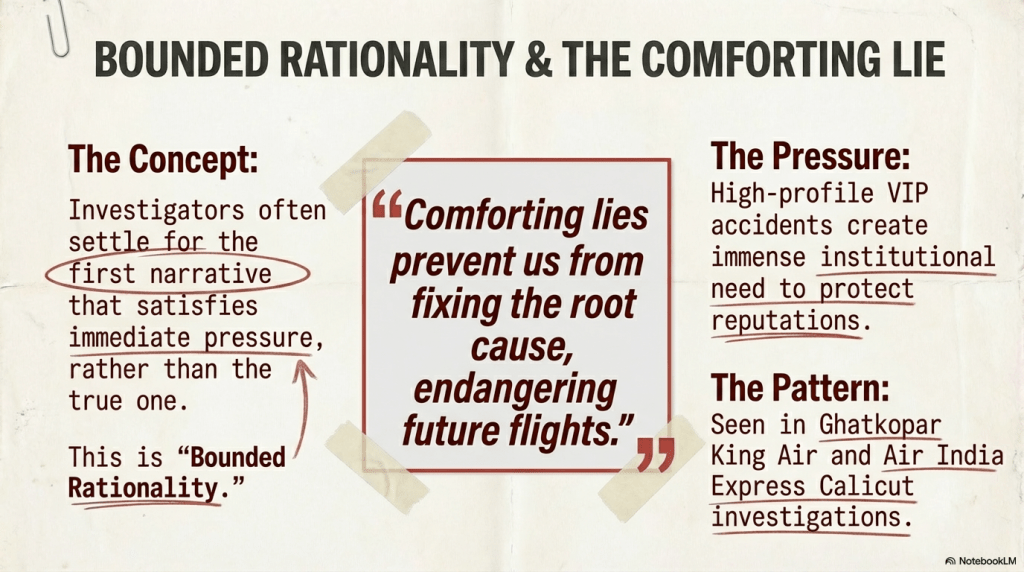
Accidents investigations in India, especially the King Air C-90 accident in which former Aviation Minister, Shri Madhav Rao Scindia died, the Ghatkopar KingAir C90 accident investigation and AirIndia Express Calicut accident investigations have been classic cases that expose chinks in almost every department in aviation, more so regulatory and investigative functions.
They also expose the fact that the investigators have the power or have acquired the power to play with facts and pieces of evidence to spawn truth.
The aim of accident investigation is to determine the root cause(s) and prevent any similar accident. However, during the process of investigation, the human bias creeps in and in a number of investigations, the purpose of the investigation is lost midway or dumped midway for vested interests. Accidents investigations in India, especially, the King Air C90 accident in which former Aviation Minister, Shri Madhav Rao Scindia died, the Ghatkopar KingAir C90 accident investigation and AirIndia Express Calicut accident investigations have been classic cases that expose chinks in almost every department in aviation, more so regulatory and investigative functions. They also expose the fact that the investigators have the power or have acquired the power to play with facts and pieces of evidence to spawn truth.
For effective investigations, collaboration among various stakeholders is crucial.This helps ensure that all aspects of an incident are thoroughly examined, which is vital for achieving accurate conclusions.
In the accident discussed above, basic facts like the prevalent weather conditions and pathological evidence were either overlooked or created to give an impression that the accident was caused by the presence of tall mighty clouds, which had the force to break apart an aircraft in flight and cause a deflagrating fire upon impact with the ground.
Humans believe in self-satisficing and bounded rationality. They will settle for the first evidence or narrative that meets their purpose and stick to it, however absurd or illogical/irrational that it could be. Human lives matter, and every effort must be made to prevent accidents by learning from present failures.
The first step is to acknowledge that something has gone wrong and that there is a need to amend processes. It is not an admission of failure, personal or institutional, but a determined effort to save lives in the future.
Discover more from Safety Matters Foundation
Subscribe to get the latest posts sent to your email.
Leave a Reply