
The so-called “black box” is not black at all: it is usually bright orange or yellow with reflective markings so it can be found after an accident. In modern transport aircraft the term refers to crash-protected flight recorders—typically a Cockpit Voice Recorder (CVR) and a Flight Data Recorder (FDR) (sometimes combined). Together they capture the two things investigators most need: what the aircraft was doing (data) and what the humans perceived, said, and decided (voice and cockpit sounds). This pairing is exactly why the device transformed aviation safety: it turns post-crash speculation into evidence, allowing learning about systems and human factors—attention, workload, startle, fixation, and team coordination.

The conceptual leap is strongly associated with Dr David Warren of Australia’s Aeronautical Research Laboratories, who in the 1950s argued that a record of flight conditions and pilot reactions in the moments before impact is of “inestimable value.” The mid-century Comet disasters highlighted the core problem: when aircraft break up at altitude with no survivors, investigators can be left with too little information. Warren’s solution was a rugged recorder that could survive a crash and preserve the story.
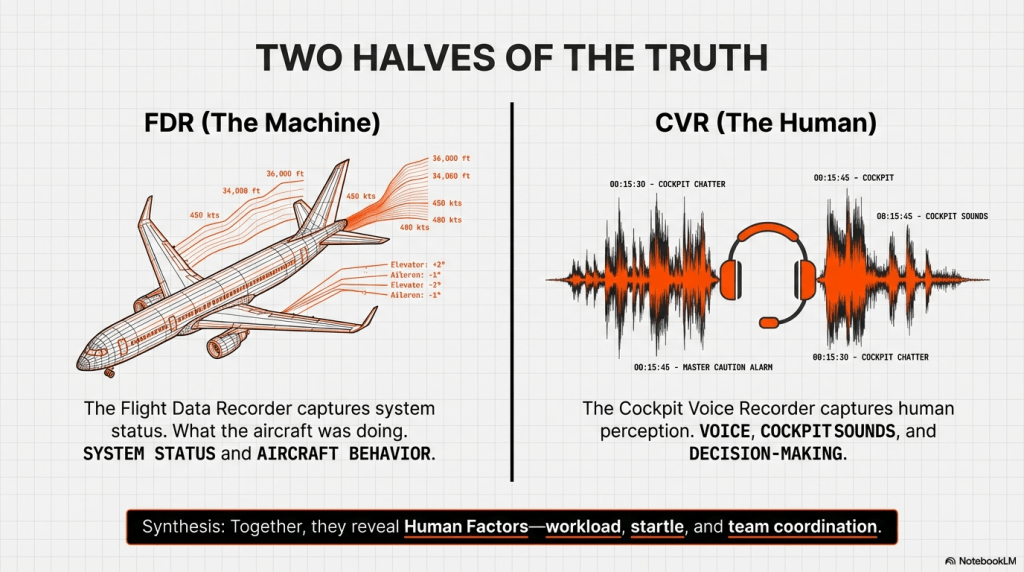
FAA/modern design intent: make it record, make it survive, make it findable

From the FAA perspective, requirements come in layers: the operating rules determine which aircraft must carry recorders, while the airworthiness rules and minimum performance standards ensure the equipment is installed to survive and is qualified to withstand crash and post-crash environments. Installation rules in transport-category design (e.g., Part 25) emphasize recorder location and mounting that minimize rupture from impact and damage from fire, along with conspicuity markings and, where required, an underwater locating device. (CVR: 14 CFR §25.1457; FDR: 14 CFR §25.1459.)
For crash-protected recorder qualification, modern FAA approvals for recorders manufactured after December 2013 align with standards such as EUROCAE ED-112A through FAA TSOs (for example, TSO-C124c for FDR) and related guidance for CVRs.
Quantitative survivability requirements (g, temperature/time, depth/pressure, crush)


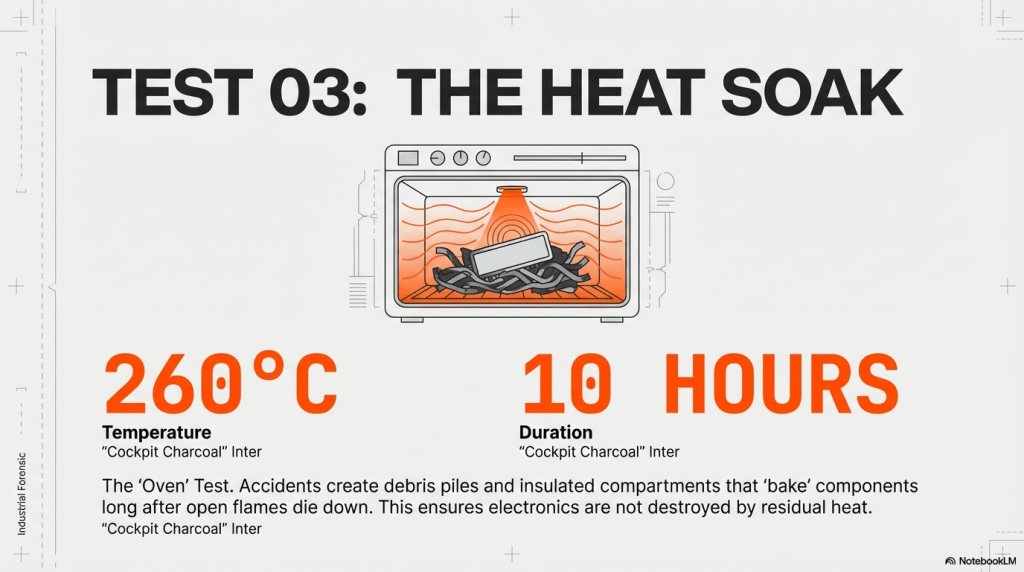
Under the widely used ED-112A crash-protected recorder baseline, crash-survivable memory is qualified against extreme conditions. A widely cited public summary of ED-112A survivability targets includes: 3,400 g impact shock; 5,000 lb static crush; 1,100°C for 1 hour (high-temperature fire); 260°C for 10 hours (low-temperature, long-duration fire/heat soak); and deep-sea pressure equivalent to 20,000 ft for 30 days.
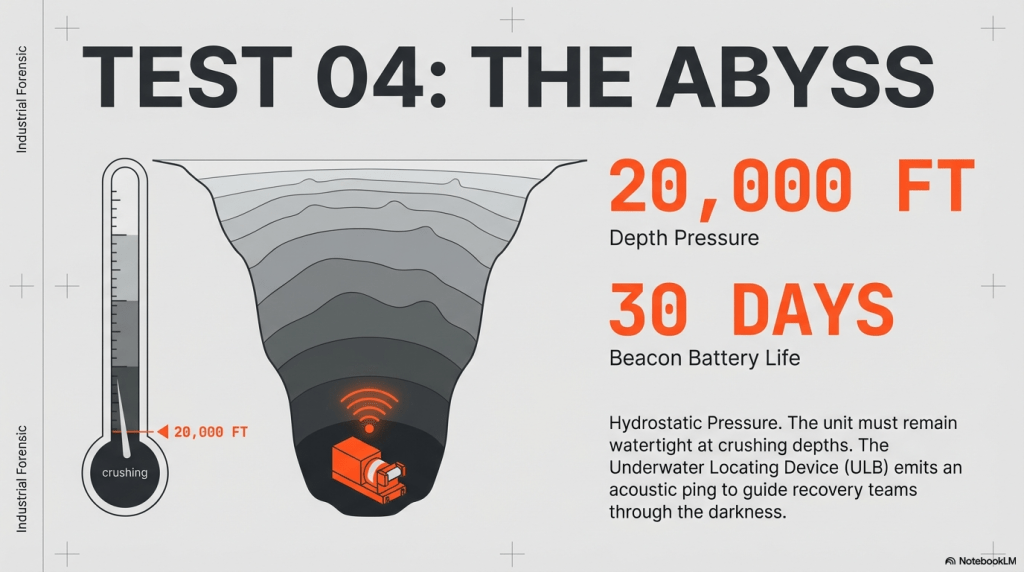
Many manufacturer and test-house summaries also express the shock as a short, severe pulse (commonly described as 3,400 g for ~6.5 ms, half-sine) and include a penetration test to ensure the memory unit resists sharp structural intrusion.
How hot is “burning jet fuel,” and why the recorder fire tests look the way they do
When people say “fuel explosion temperature,” they often mix together different concepts: real-world fire temperature, ignition/flash behavior, and theoretical combustion maxima. For recorder survivability, what matters is post-crash fire exposure—not just a brief flash, but sustained heating while surrounded by wreckage.
A hydrocarbon jet/pool fire is commonly characterized around ~1,100°C, which matches the recorder’s 1,100°C for 1 hour qualification intent: survive an intense, sustained fuel-fed fire long enough to preserve data.
But accidents also produce long-duration lower-temperature heating—smouldering materials, debris piles, insulated compartments, and wreckage that “bakes” components. That is why ED-112A also requires survivability at 260°C for 10 hours: it represents the slow, persistent heat soak that can destroy electronics even without dramatic flames.
For comparison, there is also a theoretical upper bound: the adiabatic flame temperature of jet fuel/air mixtures (perfect mixing, no heat losses) can be on the order of ~2280–2300 K (about ~2000°C). This is not a typical accident-site condition, but it explains why “maximum flame temperature” figures can sound much higher than the ~1100°C used in practical qualification testing.
Fire references also note that ordinary combustibles can reach ~1000°C to 2000°C depending on conditions—again highlighting why standards use representative, repeatable test exposures rather than chasing a single “explosion temperature” number.

The safety payoff
In safety terms, the black box is a disciplined way of practicing what aviation claims to value: learning over blame. It preserves the evidence needed to see where humans and systems drifted into trouble—mode confusion, unstable approach continuation, checklist breakdown, cognitive lock-up, fatigue effects, or weak monitoring—and it enables changes in training, SOPs, design, and regulation. For deeper reflection on these human-factor mechanisms (especially fixation and “cognitive lock-up”), Capt. Amit Singh’s mindFly: Follies, Realities and Human Factors is an excellent companion text.

Discover more from Safety Matters Foundation
Subscribe to get the latest posts sent to your email.

