


Why Don’t Trains Have Seat belts? Understanding the Science and Safety of Railway Travel
Table of Contents
Introduction
In cars and airplanes, seat belts are a crucial safety feature. They protect passengers from the dangers of sudden stops, collisions, and inflight turbulence. However, when you board a train, you’ll notice something surprising—no seat belts. At first glance, this might seem like a glaring oversight, but the absence of seat belts in trains is actually a carefully considered decision based on the unique safety dynamics of rail travel. In this blog, we’ll explore why trains don’t require seat belts, the purpose of seat belts in other vehicles, and key differences between seat belt designs in airplanes and cars. We will also examine accident statistics and offer graphs to illustrate these points.

Seat belts: Designed for Inflight Turbulence, Not Accidents
Seat belts serve a very specific purpose in airplanes. Their primary function is to protect passengers from inflight turbulence, not accidents. Turbulence, caused by air currents, can make the plane shake or drop unexpectedly. In such cases, passengers without seat belts can be thrown from their seats, leading to injury. This is why airlines insist that seat belts remain fastened throughout the flight, even when cruising at a steady altitude.
However, when it comes to airplane accidents—especially during takeoff or landing—traditional lap seat belts may not provide adequate protection. Studies, including a 2020 case report, have shown that lap seat belts can cause serious injuries during accidents. One passenger in a landing accident sustained severe spinal and abdominal injuries due to the seat belt’s failure to restrain her upper body.
This is why some experts suggest the use of a 3- or 4-point harness in airplanes, similar to those used in cars. These seat belts, which strap across both the shoulder and waist, offer better protection in a wider range of scenarios, from turbulence to emergency landings.
The Purpose of Seat belts in Cars
Seat belts are vital for preventing injury in car collisions. The sudden deceleration experienced during a car crash can propel passengers forward at high speeds, causing serious or even fatal injuries. Seatbelts, especially modern 3-point systems, help distribute the forces of the crash across the stronger parts of the body, like the chest, pelvis, and shoulders, thereby reducing the risk of injury.
While seatbelts work well in cars because of the high probability of sudden, severe impacts, trains operate under completely different circumstances. Trains are heavy, follow fixed tracks, and are much less likely to experience the kind of rapid deceleration seen in car accidents.
Why Trains Don’t Have Seat belts
- Train Travel’s Smooth Nature
Trains follow a smooth, predictable path along dedicated tracks, reducing the likelihood of sudden or erratic movements. Unlike cars, which share the road with other unpredictable vehicles, or airplanes that can experience sudden turbulence, trains move steadily along their routes. Because of this, passengers are not subjected to the same kind of forces that make seat belts necessary in cars and airplanes. - Mass and Momentum
Trains are massive vehicles that can weigh thousands of tons. This mass plays a critical role in their safety dynamics. The larger the mass, the more difficult it is to bring the vehicle to a sudden stop. When a train does decelerate, it usually happens gradually over a long distance, which significantly reduces the force experienced by passengers. In comparison, the rapid deceleration in car accidents exerts intense forces on the body, making seat belts essential. - Train Accidents Are Rare
Statistically, train accidents are far less common than car accidents. According to the U.S. Federal Railroad Administration (FRA), trains account for less than 0.1% of transport-related fatalities each year. In contrast, car accidents result in over 35,000 deaths annually in the U.S. alone, according to the National Highway Traffic Safety Administration (NHTSA). The rarity of train accidents, combined with the gradual nature of deceleration in most railway mishaps, further reduces the need for seat belts. - The Danger of Restriction
In the rare event of a train crash or derailment, being strapped to a seat could actually pose more danger than protection. Passengers may need to move freely to escape from a tipped or damaged carriage. Seat belts would restrict their movement, potentially trapping them in life-threatening situations. For example, a train car could overturn, and passengers may need to move quickly to avoid injury from falling luggage or fires.
Two-Point vs. Three-Point Seat belts in Trains and Airplanes
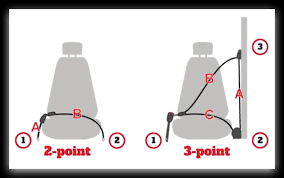
There are several seat belts, each designed for different levels of protection and convenience. Let’s explore the key differences between two-point and three-point seat belts in airplanes and why neither is necessary on trains.
- Two-Point Seat belts
- Airplanes: The most common seatbelt found on airplanes is the two-point seatbelt, often called a lap belt. This belt wraps around the waist and keeps passengers seated during turbulence. While effectively securing passengers for short-term jostling, lap belts offer little protection during crash landings or accidents. They can cause serious injuries like spinal fractures or internal damage due to the lack of upper body restraint【5†source】.
- Trains: Trains do not typically use two-point seatbelts because of the lower risk of sudden deceleration. Unlike planes, trains do not face turbulence, and their slow deceleration in accidents makes lap belts unnecessary. Passengers in trains are also seated in larger compartments where seatbelts would restrict movement more than provide protection.
- Three-Point Seat belts
- Airplanes: Some private or first-class seats in airplanes are equipped with three-point seatbelts, which are similar to those used in cars. These belts cross both the shoulder and the waist, providing more comprehensive restraint during turbulence or an emergency landing. Though they offer better protection than two-point belts, they are still not the norm in most passenger cabins.
- Trains: Trains do not use three-point seatbelts because the design and structure of train travel do not necessitate this level of restraint. The slow deceleration in train accidents means that passengers are not subjected to the same forces as in car accidents, where three-point seatbelts are critical for safety.
Statistical Analysis: Comparing Accident Rates and Safety in Different Transport Modes
Train accidents are significantly less common than car or plane accidents. To illustrate this, consider the following statistics:
- Train Accident Fatalities: According to the Federal Railroad Administration, fewer than 300 fatalities related to train accidents occurred in the U.S. between 2000 and 2020.
- Car Accident Fatalities: Over the same period, car accidents claimed an average of 35,000 lives annually, making driving the most dangerous mode of transportation.
- Airplane Accidents: Air travel is statistically safer than driving, but turbulence injuries are common. In 2019, the FAA reported that approximately 58 passengers were injured yearly due to turbulence.

- Cars: According to the World Health Organization (WHO), road traffic accidents cause around 1.35 million deaths yearly.
- Airplanes: Aviation is extremely safe globally. The International Air Transport Association (IATA) reports fewer than 500 fatalities annually from commercial aviation accidents.
- Trains: According to global railway safety reports, rail-related accidents cause approximately 1,000-1,500 deaths yearly worldwide. This figure includes incidents like derailments, collisions, and pedestrian accidents involving trains.

Fig. 1: Comparison of Accident Rates for Cars, Trains, and Airplanes.
Another critical factor is the forces passengers experience in accidents. Trains experience far lower G-forces (a measure of acceleration) during crashes than cars or aeroplanes. This lower impact reduces the need for seat belts.

Fig. 2: G-Forces in Cars, Planes, and Trains During Accidents.
Why Adding Seat Belts to Trains Could Increase Risk
Two point seatbelts can cause internal injuries thereby immobilising the e occupant. This is also called the seat belt syndrome.

While seatbelts are necessary for cars and aeroplanes, adding them to trains could introduce new risks. In the event of a derailment or collision, passengers might be better off moving away from their seats. Being strapped into a seat could prevent them from escaping quickly, especially when a train car is tipping over or a fire breaks out. This potential for restricted movement in emergencies is one of the primary reasons why seatbelts are not installed in trains.
Conclusion: Trains and the Calculated Exclusion of Seat belts
While seatbelts are essential in cars and airplanes, their absence on trains is a deliberate decision backed by safety data and the mechanics of train travel. Trains, with their fixed paths, heavy mass, and smooth operation, present far fewer opportunities for sudden deceleration or collisions compared to cars or airplanes. The rarity of accidents, the slow nature of train deceleration, and the need for freedom of movement during emergencies all contribute to the decision to exclude seatbelts from train travel.
Thus, while seat belts play a critical role in protecting passengers in cars and planes, they are not necessary in trains. Instead, the structure of rail travel and the design of train carriages ensure that passengers can travel safely without the need for restraint systems. The lack of seatbelts in trains is not an oversight—it’s a well-informed choice based on decades of transport safety research.
References
- Federal Railroad Administration, U.S. Department of Transportation.
- National Highway Traffic Safety Administration (NHTSA).
- Seat Belt Syndrome: Study of Airplane and Automobile Injuries, 2020.
Discover more from Safety Matters Foundation
Subscribe to get the latest posts sent to your email.
Leave a Reply