


Policy Position: Every Metro Should Have One Dedicated Low-Cost Airport
India’s metros do not suffer from a lack of airports; they suffer from a lack of choice. When premium, capital-intensive hub airports are expected to simultaneously serve luxury long-haul travel and price-sensitive mass mobility, the result is predictable—higher charges, rising airfares, congestion, and a gradual erosion of affordability. If India is serious about making air travel accessible rather than aspirational, every metropolitan region must have one dedicated low-cost airport, designed, regulated, and priced for efficiency rather than grandeur. This is not an infrastructure indulgence; it is a structural necessity for a country where the majority of flyers are first-time, fare-sensitive passengers.
1. Why a Dedicated Low-Cost Airport per Metro Makes Sense
a) Cost Segregation Is Fundamental
Aviation costs are largely structural, not incidental. When low-cost carriers (LCCs) operate from the same terminals as full-service carriers at premium hubs, they are forced to absorb:
- High User Development Fees (UDF)
- Premium terminal operating costs
- Congestion-driven inefficiencies
- Slot scarcity premiums
A separate low-cost airport allows:
- Bare-bones terminals
- Faster turnarounds
- Lower aeronautical charges
- Predictable cost bases for airlines
This model works globally.
Examples (success cases):
- London → Stansted / Luton alongside Heathrow
- Paris → Beauvais alongside CDG
- Tokyo → Narita / Haneda segregation
- Kuala Lumpur → KLIA2 for LCCs
These are not accidental outcomes; they are deliberate infrastructure economics decisions.
2. Why Indian Metros Are Currently Structurally Misaligned
India’s metro airports (Delhi, Mumbai, Bengaluru, Hyderabad) follow a single-hub, premium-first model, characterised by:
- Large capex recovery pressures
- Non-aeronautical revenue dependency
- Uniform fee structures irrespective of airline business model
This creates a contradiction:
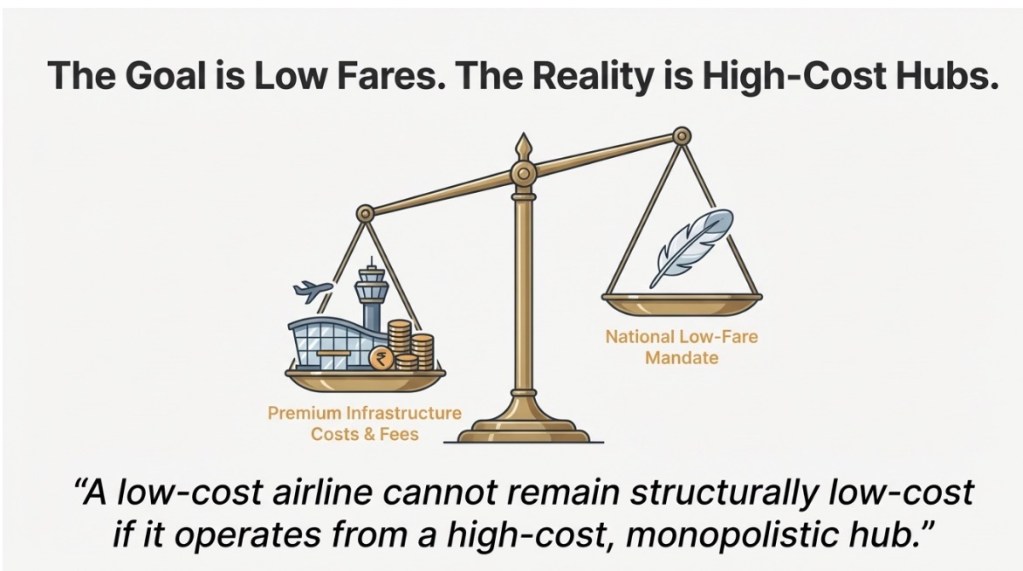
India wants low fares, but builds airports priced for premium passengers.
A low-cost airline cannot remain structurally low-cost if it operates from high-cost monopolistic hubs.
3. What “One Low-Cost Airport per Metro” Should Actually Mean
This is critical. A low-cost airport is not merely a smaller airport.
It must have policy-mandated characteristics:
A. Regulatory Design
- Zero or near-zero UDF
- Minimal PSF
- Transparent, capped aeronautical charges
- Separate AERA tariff philosophy (cost-based, not ROI-maximising)
B. Infrastructure Philosophy
- Single terminal, modular design
- Walk-boarding or basic aero-bridges
- No luxury retail dependency
- Standardised ground handling
C. Operational Priorities
- Guaranteed fast turnarounds
- Slot availability prioritised for LCCs
- No cross-subsidisation of premium terminals
D. Connectivity Integration
- Direct metro/rail/bus links
- Time-based accessibility targets (e.g. <60–75 minutes from CBD)
4. Why “Dual-Airport” Models Are Essential for Large Cities
Large metros naturally generate two distinct demand profiles:
- Time-sensitive, premium, long-haul, business travel
- Price-sensitive, short-haul, leisure, regional travel
Trying to serve both from one airport results in:
- Congestion
- High costs
- Political capture of tariff regulation
- Airline-airport conflict
A dual-airport strategy is therefore not duplication — it is demand segmentation.
5. Risks and Caveats (Important)
I would add three cautions:
a) Avoid “Low-Cost in Name Only”
If a low-cost airport:
- Is controlled by the same concessionaire
- Has the same tariff logic
- Exists mainly as overflow capacity
Then the policy fails.
b) Prevent Monopoly Extension
The low-cost airport must not become a shadow monopoly of the primary hub operator.
c) Safety and Oversight Must Be Identical
Low-cost must never mean:
- Lower safety oversight
- Reduced regulatory compliance
- Weaker emergency infrastructure
Cost efficiency ≠ safety dilution.
6. Strategic Recommendation for India
A rational national policy would be:
Every metro with annual traffic >25 million passengers must have:
- One primary hub airport
- One designated low-cost airport with a legally protected low-cost mandate
This should be embedded in:
- National Civil Aviation Policy
- AERA tariff frameworks
- Future PPP concession templates
7. Bottom Line
Yes — every metro should have one low-cost airport.
Not as an experiment, not as a political announcement, but as a structural correction to India’s aviation cost architecture.
Without this:
- Fares will keep rising
- Airlines will keep blaming airports
- Airports will keep blaming regulation
- Passengers will keep paying for inefficiency
Discover more from Safety Matters Foundation
Subscribe to get the latest posts sent to your email.

Leave a Reply