Why the “Big Five” Failed, Together — and Why an Ethics Officer Is No Longer Optional?
The aviation industry keeps searching for fixes in the wrong places.
After every crisis, we recalibrate simulators, rewrite manuals, issue new advisories, and reassure ourselves that technology or training will save us next time. Yet the failures repeat—across geographies, fleets, and decades.
The reason is uncomfortable but clear:
Modern aviation does not fail technically first.
It fails ethically first.
The collapse of what insiders often describe as the “Big Five” proves it.
The Big Five didn’t fail independently. They failed as a system.
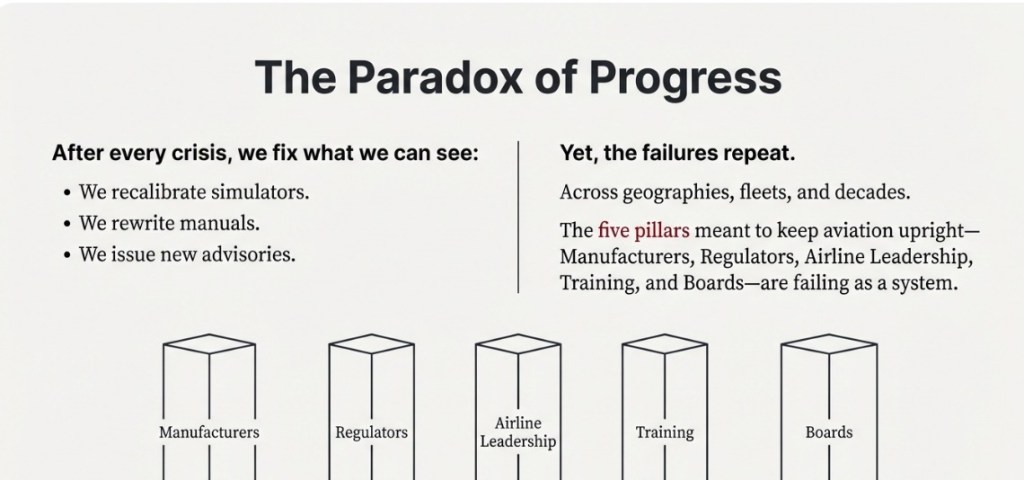
The five pillars meant to keep aviation upright are well known:
- Manufacturers
- Regulators
- Airline leadership
- Training and certification systems
- Boards, oversight, and organisational culture
Each insists it fulfilled its mandate.
Collectively, the system still failed.
That paradox is not accidental. It is systemic.
Manufacturer: when truth became negotiable
The issue was never engineering competence.
It was selective honesty under pressure.
Risk was reinterpreted.
Assumptions were stretched.
Internal concerns were heard—but overridden.
Not because people were reckless, but because schedule, market share, and reputation quietly outranked transparency.
The first ethical fracture appeared here:
when full truth became inconvenient.
Regulator: when oversight softened into alignment
Regulators did not abandon safety.
They absorbed industry pressure.
Delegation expanded faster than challenge.
Economic competitiveness entered safety conversations.
Independence blurred into partnership.
The second ethical fracture:
oversight slowly stopped asking uncomfortable questions.
Airline leadership: when silence was learned
Inside airlines, slogans stayed intact:
“Safety is our highest priority.”
On the line, reality taught a different curriculum.
Crews learned:
- which delays were “acceptable”
- which fatigue was “normal”
- which reports were “career-limiting”
- which truths were best left unsaid
No memo ordered silence.
Culture taught it.
The third ethical fracture:
when speaking up became unsafe without anyone having to threaten it.
Training and certification: when thinking was replaced by ticking
Training did not disappear.
It became minimum viable.
Designed to:
- satisfy audits
- pass checks
- demonstrate compliance
Human factors became slides, not lived philosophy.
Judgment was assumed to emerge from procedures.
The fourth ethical fracture:
learning optimised for optics, not reality.
Boards and culture: when ethics was assumed, not governed
Boards asked:
- “Are we compliant?”
- “Are we certified?”
- “Are we legally covered?”
Rarely did they ask:
- “Are people afraid?”
- “What truths are we not hearing?”
- “Who protects ethical dissent?”
Ethics was treated as a personal virtue, not an organisational responsibility.
The fifth—and decisive—ethical fracture:
no independent moral authority in the room.
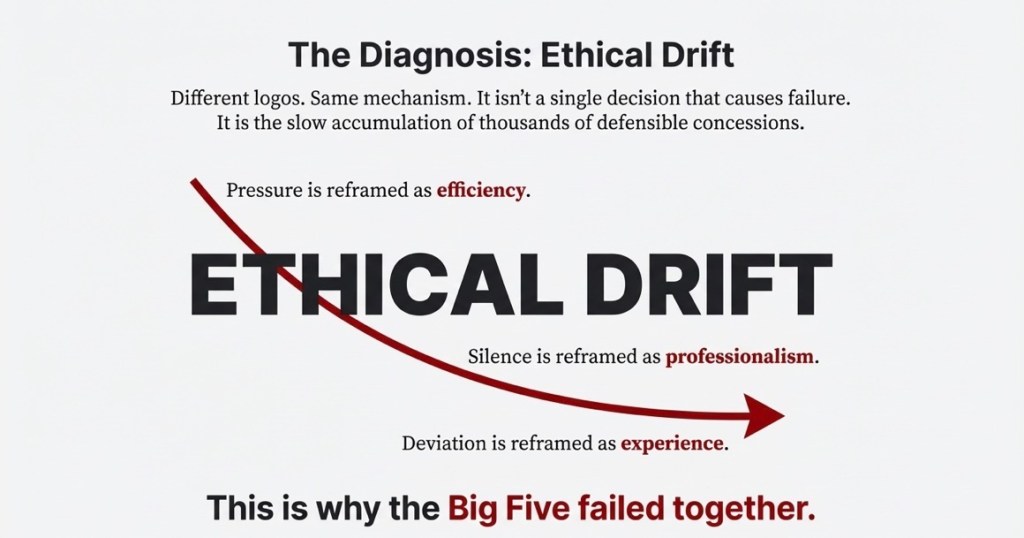
The common thread: ethical drift
Different logos. Same mechanism.
Small compromises accumulated:
- pressure reframed as efficiency
- silence reframed as professionalism
- deviation reframed as experience
No single decision caused failure.
Thousands of defensible ethical concessions did.
This is why the Big Five failed together.
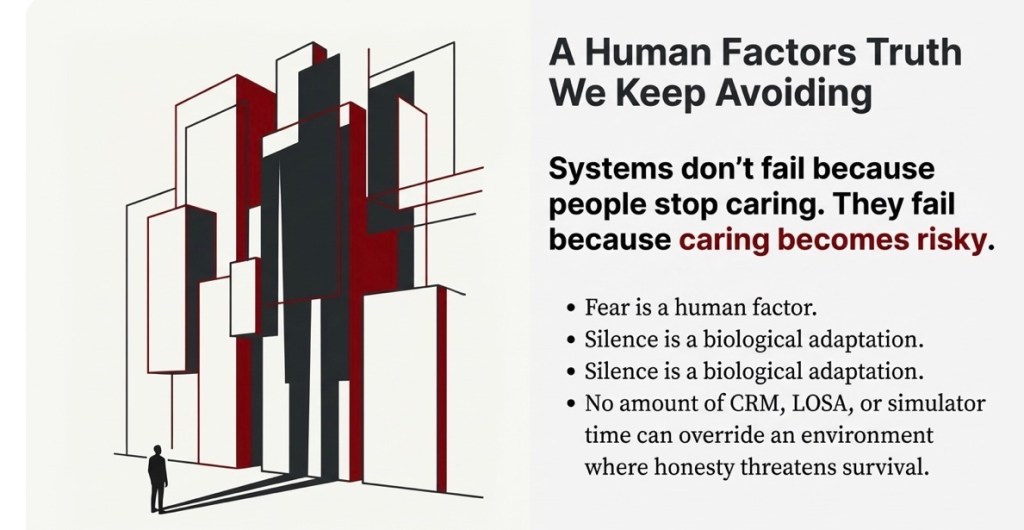
A human factors truth we keep avoiding
From a cockpit psychology perspective:
Systems don’t fail because people stop caring.
They fail because caring becomes risky.
Fear is a human factor.
Silence is a biological adaptation.
No amount of CRM, LOSA, or simulator time can override an environment where honesty threatens survival.
Why aviation keeps repeating the cycle
Because the industry keeps fixing:
- technology
- procedures
- manuals
while avoiding:
- power asymmetry
- fear-based cultures
- ethical accountability
Ethics is treated as an attitude problem.
In reality, it is a design problem.
The missing safety barrier: an independent Ethics Officer
Aviation safety models talk about barriers—technical, procedural, operational.
But the first barrier to fail is ethical.
This is why airlines, manufacturers, and regulators urgently need a Corporate Ethics Officer—not as symbolism, but as structure.
What this role must be (and must not be)
- Independent of commercial pressure
- Direct access to the Board
- Separate from HR, legal, and safety silos
- Mandated to protect truth, dissent, and fairness
The Ethics Officer exists to ask the question others are incentivised not to ask:
- Is this right—or merely defensible?
- Are we protecting safety—or protecting ourselves?
- What are people afraid to say—and why?
Without this role, ethics remains optional.
And optional ethics always loses to quarterly pressure.

An older wisdom aviation has forgotten
Indian thought offers a warning modern governance ignores.
Dharma erodes not in dramatic collapse, but through small justifications.
Karma-yoga demands right action without attachment to reward or fear.
Translated into aviation:
- Do the right thing even when it delays a flight
- Speak the truth even when it costs promotion
- Protect life over image
An Ethics Officer institutionalises this wisdom—not spiritually, but operationally.

Final thought
The Big Five did not fail because they were incompetent.
They failed because ethics was left unguarded.
Until aviation recognises ethics as a safety-critical function, not a moral accessory, the industry will keep asking what went wrong—long after people inside already knew.
Airlines don’t have a safety problem.
They have an ethics problem.
And ethics, when ignored, always sends the bill later.
Discover more from Safety Matters Foundation
Subscribe to get the latest posts sent to your email.

