


Insulating India’s Aviation Regulators for Safety




A Governance, Legal, and Safety Framework for India
Executive Summary
The proposal to establish an independent Civil Aviation Authority (CAA) in India is frequently presented as a structural solution to regulatory weakness, conflicts of interest, and declining safety credibility. International and Indian experience, however, demonstrates that formal independence is neither sufficient nor durable unless supported by robust institutional insulation.
This White Paper argues that the central challenge is not independence per se, but how an independent regulator can be insulated from both corporate capture and governmental interference—particularly in a political-administrative ecosystem such as India’s, where informal power, transfers, budgetary control, and post-retirement incentives exert significant influence.
The paper draws upon:
- Scholarly research on regulatory capture and independent regulatory agencies (IRAs)
- Comparative governance experience from Asia and mature aviation regulators
- ICAO principles of State safety oversight
- Indian constitutional and parliamentary practice
It proposes a multi-layered insulation framework, coupled with a balanced parliamentary oversight mechanism that preserves democratic accountability without turning the regulator into an extension of the ruling executive.
1. Introduction and Problem Statement
India’s aviation sector is safety-critical, capital-intensive, and politically visible. Regulatory decisions directly affect commercial viability, employment, connectivity, and public confidence. In such an environment, aviation regulators face continuous pressure from:
- Corporate actors seeking commercial relief or regulatory forbearance
- Line ministries seeking political or economic outcomes
- Crisis-driven public and judicial expectations for blame attribution
Empirical research on independent regulatory agencies in India and Asia shows that regulators often become “independent on paper but dependent in practice”, particularly when appointments, budgets, careers, and enforcement discretion remain vulnerable to influence.
In aviation, this risk is existential: regulatory weakness ultimately manifests as accidents, erosion of trust, and international credibility loss.
2. Conceptual Framework: Independence vs Insulation
2.1 Independence
Independence refers to:
- Statutory autonomy
- Organisational separation from ministries
- Formal decision-making authority
2.2 Insulation
Insulation refers to the regulator’s sustained ability to take technically correct, safety-first decisions:
- Without fear of political retaliation
- Without economic pressure from regulated entities
- Without personal or career incentives aligned to the industry
| Dimension | Independence | Insulation |
|---|---|---|
| Nature | Legal | Operational & cultural |
| Focus | Structure | Behaviour under pressure |
| Time horizon | Short-term | Sustained |
This paper treats insulation as the primary design objective.
3. Layer I – Legal and Statutory Insulation
3.1 Clear and Narrow Statutory Mandate

The founding legislation must state unambiguously:
“The overriding objective of the Civil Aviation Authority shall be the protection of aviation safety and the public interest. Economic growth, connectivity, or commercial considerations shall not override safety determinations.”
This language is essential to withstand ministerial, industry, and judicial pressure.
3.2 Limits on Ministerial Direction
Best practice and scholarship recommend:
- Prohibition of case-specific or operator-specific directions
- Allowance only for general policy guidance, issued transparently
- Mandatory publication of all directions
This prevents informal or opaque executive interference.
3.3 Security of Tenure
- Fixed, non-renewable terms for Chairperson and Board members
- Removal only through a defined, quasi-judicial process
- Explicit protection against suspension, transfer, or re-assignment
This addresses a common Asian failure mode: discipline through transfer or threat thereof.
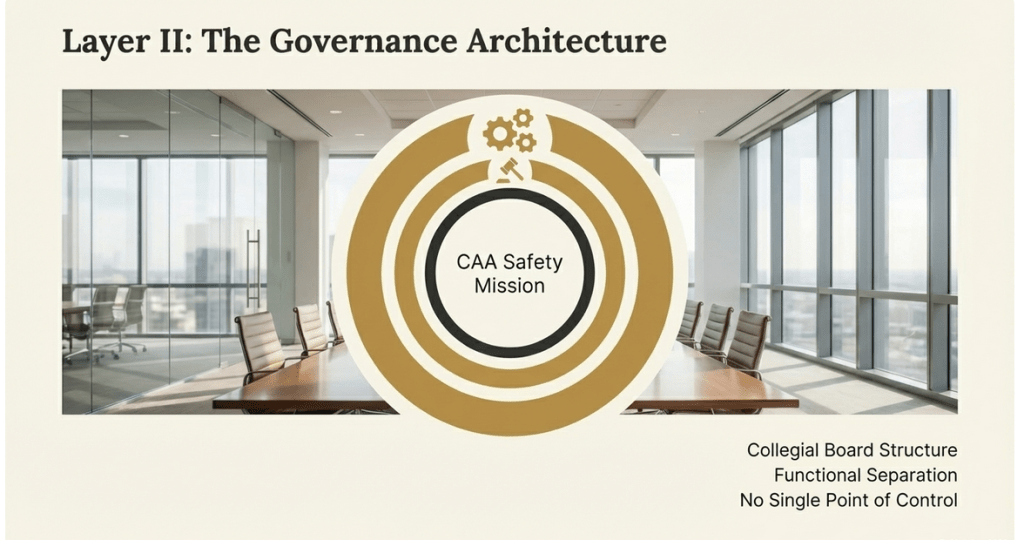
4. Layer II – Governance Architecture
4.1 Collegial Board Structure
A multi-member board reduces vulnerability to capture and intimidation. The board should include:
- Safety and operations expertise
- Engineering and airworthiness expertise
- Human factors and systems safety expertise
- Legal and public administration expertise
No single individual should control certification, surveillance, and enforcement.
4.2 Functional Separation
Clear separation between:
- Rule-making
- Certification and licensing
- Surveillance and enforcement
- Accident investigation (outside the CAA)
The concentration of these functions has historically increased capture risk.
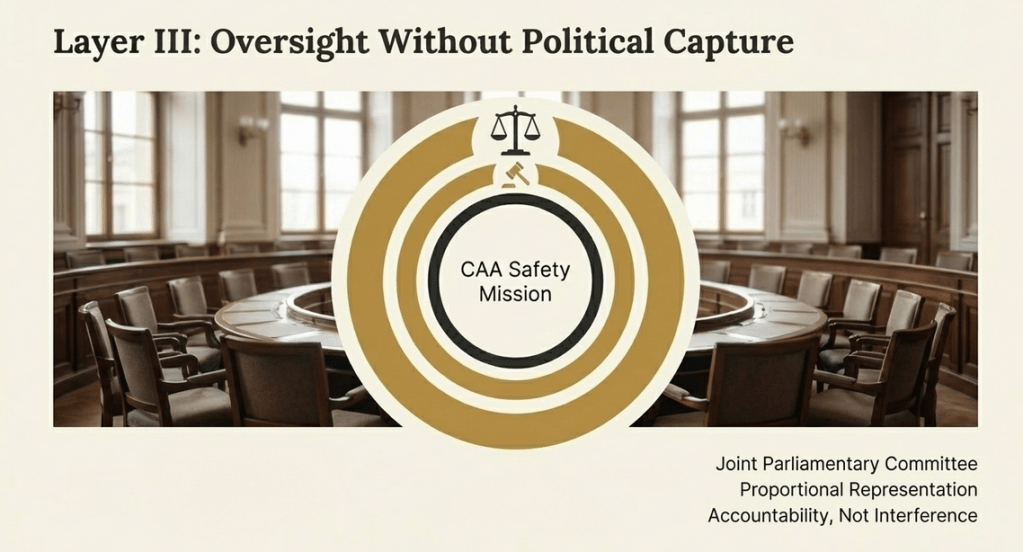
5. Layer III – Parliamentary Oversight Without Political Capture
5.1 Why Parliamentary Oversight Matters
Democratic accountability is essential. However, ministerial control is not democratic accountability. Scholarly research shows that regulators are most resilient when accountable to the legislature rather than the executive.
5.2 Balanced Parliamentary Panel Design
To avoid a tilt towards the ruling government, the Parliamentary Oversight Panel should:
- Be a Joint Parliamentary Committee (JPC)
- Include proportional representation from:
- Ruling party
- Principal opposition
- Smaller parties
- Be chaired alternately or by consensus, not automatically by the ruling party
5.3 Scope of Parliamentary Oversight
The panel shall:
- Review annual safety and performance reports
- Examine systemic issues and audit outcomes
- Summon CAA leadership for an explanation on governance and process
The panel shall not:
- Intervene in individual certification or enforcement decisions
- Direct technical or operational outcomes
This distinction preserves independence while ensuring accountability.
6. Layer IV – Human Capital and Career Insulation
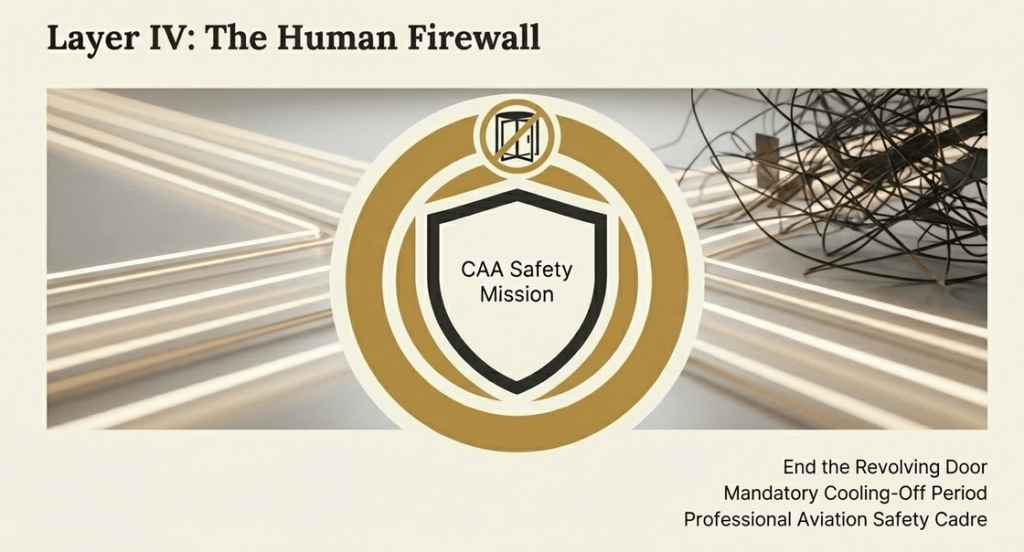
6.1 Ending the Revolving Door
International research consistently identifies revolving-door employment as a primary vector of capture.
Recommended measures:
- Mandatory cooling-off period of 3–5 years
- Prohibition on post-tenure employment in regulated entities
- No deputation from airlines or airports into safety oversight roles
6.2 Professional Aviation Safety Cadre
- Establish a permanent technical cadre
- Limit generalist civil service postings
- Promotions based on competence and integrity, not seniority
7. Layer V – Financial Insulation

7.1 Independent Funding Mechanism
- Statutory levy on aviation activity
- Funds are credited directly to the CAA
- No discretionary annual grants controlled by ministries
7.2 Budget Stability
- Multi-year budget approvals
- Protection against retaliatory budget cuts following enforcement action
Financial dependence is among the most subtle and effective tools of influence.
8. Layer VI – Transparency and Ethics
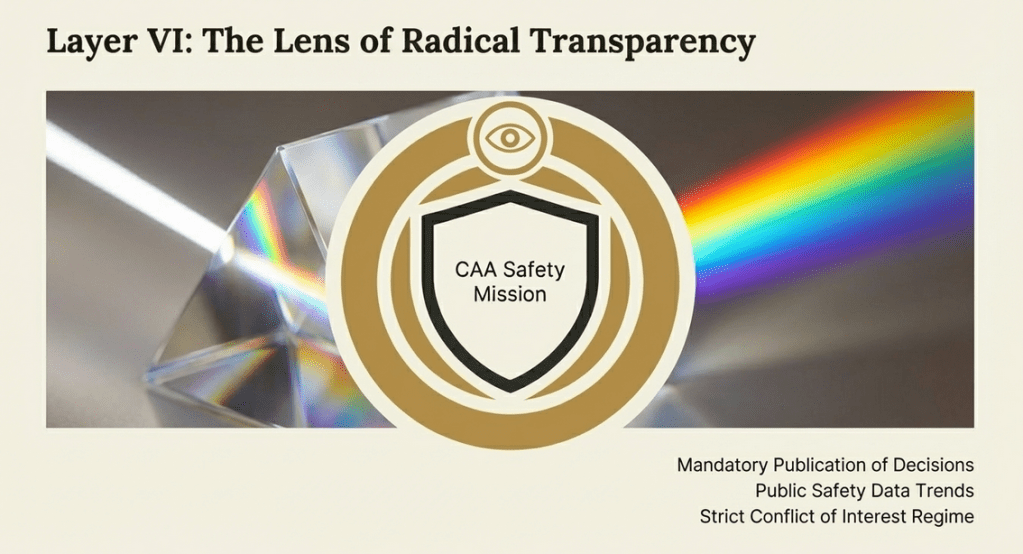
8.1 Radical Transparency
Mandatory publication of:
- Certification rationales
- Audit findings (with safety-critical redactions only)
- Enforcement actions
- Safety data trends
8.2 Conflict of Interest Regime
- Annual public declarations by senior officials
- Independent verification
- Statutory penalties for nondisclosure
9. Layer VII – Cultural and Ethical Insulation

Rules cannot substitute for ethics. In the Indian context, regulators must internalise:
- Dharma: duty beyond hierarchy
- Karma-yoga: action without attachment to personal outcomes
A regulator anchored in ethical duty is harder to corrupt than one anchored only in procedure.
10. Process for Implementation
- Draft and introduce a standalone CAA Bill
- Pre-legislative consultation with the public and experts
- Parliamentary committee scrutiny (cross-party)
- Enactment with sunset review clause (5 years)
- Independent post-implementation review
11. Conclusion
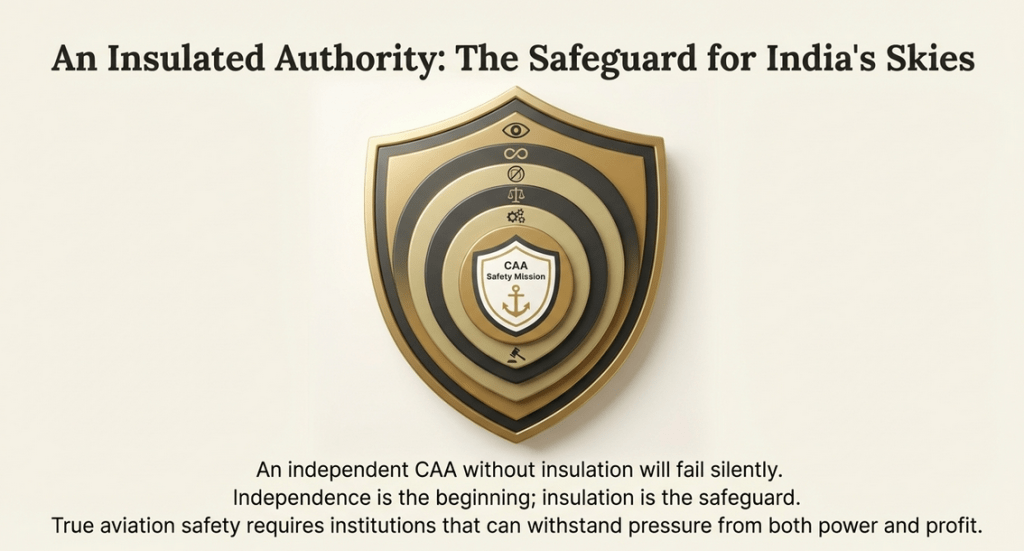
An independent CAA without insulation will:
- Appear credible
- Function procedurally
- Fail silently
True aviation safety requires institutions that can withstand pressure from both power and profit. Independence is the beginning; insulation is the safeguard.
References (Indicative)
- ICAO Doc 9734 – Safety Oversight Manual
- ICAO Doc 9859 – Safety Management Manual
- Stigler, G. (1971). The Theory of Economic Regulation
- Carpenter, D. (2010). Reputation and Power
- Kumar, S. (2020). Independent Regulatory Agencies in India
- World Bank (1999). Challenging Corruption in Asia
- OECD (2013). Specialised Anti-Corruption Institutions
Discover more from Safety Matters Foundation
Subscribe to get the latest posts sent to your email.
Leave a Reply