The next time a flight suffers a violent jolt during take-off, the cause may not be a technical failure inside the aircraft at all. It may be the result of a far more familiar failure on the ground: poor urban planning, weak municipal enforcement, and ecological neglect just beyond the airport perimeter wall.
Wildlife hazard at Indian airports is no longer merely an aviation issue. It is increasingly the visible expression of failures in civic governance outside the airport fence. The runway environment has become the final stage on which the consequences of open waste, stagnant water, uncontrolled meat disposal, and illegal slaughter activity are played out.

Figure 1 – The Alarming Trajectory of Bird Strikes]
The numbers leave little room for comfort. Even if the Government of India attributes part of the increase to improved reporting, the jump to 1,782 confirmed bird-hit incidents in 2025 is still a serious warning. The real issue is not only how many strikes are reported, but whether the ecological conditions that attract birds are being reduced in any meaningful way. On that test, India is still falling short.
A bird strike is never just a maintenance event. It can force flight crews into a sudden, high-workload state during the most critical phases of flight — take-off and landing — when task saturation, startle, and diagnostic confusion can escalate rapidly.
——————————————————————————–
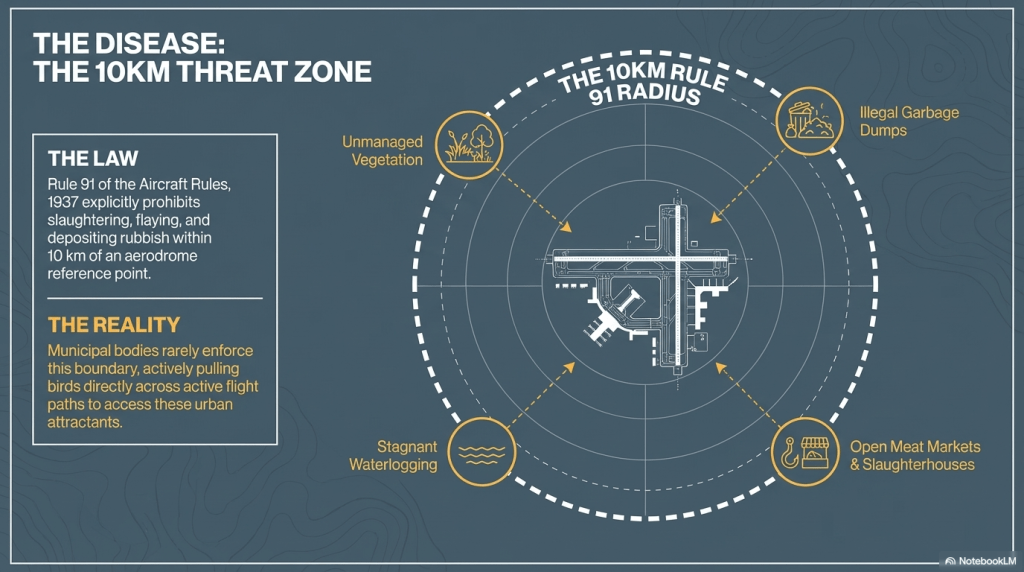
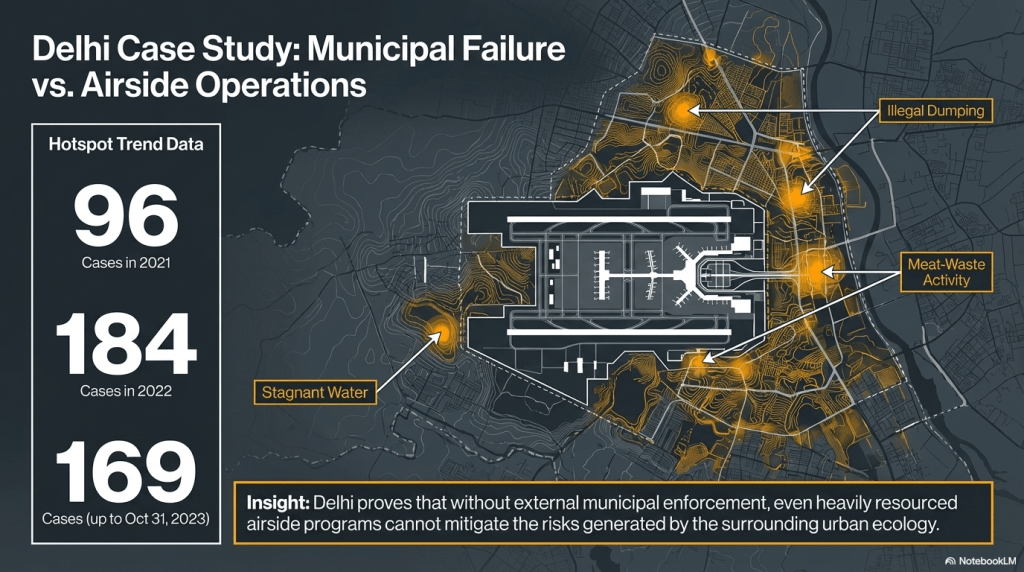
Figure 2 – Delhi’s Urban Ecological Disaster Map]
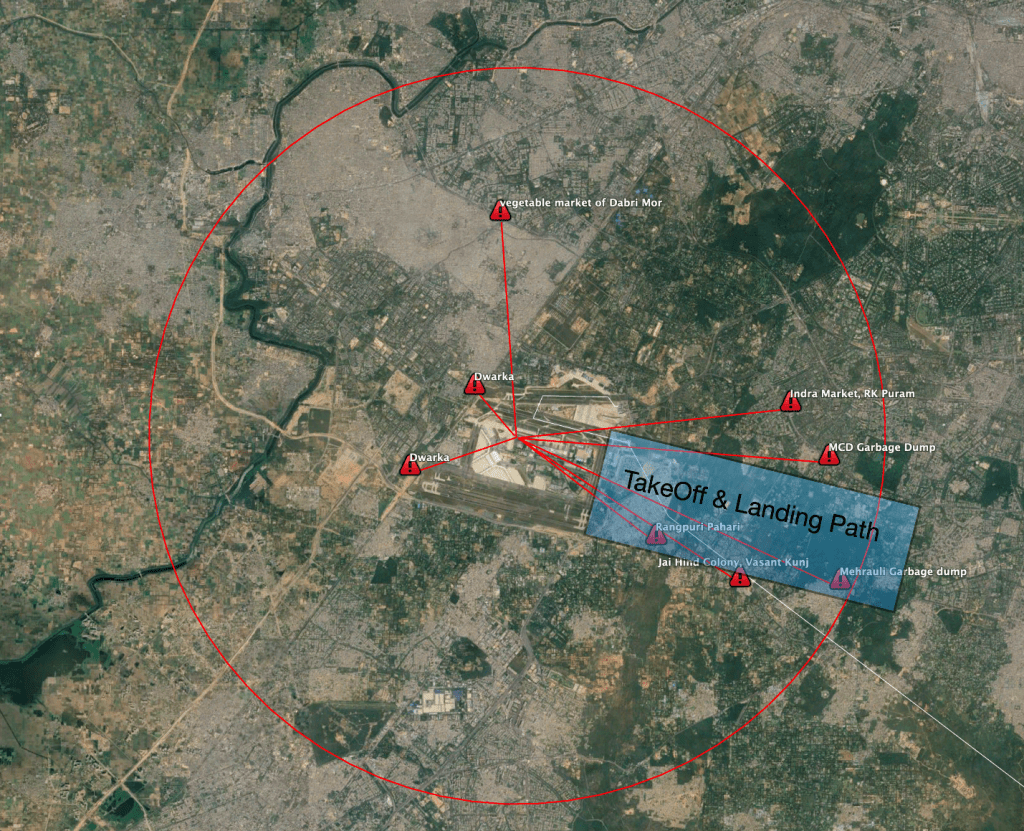
Delhi offers one of the clearest illustrations of how off-airport conditions can generate aviation risk. The hazard hotspots around the capital’s airport point directly to failures in the surrounding urban environment. These are not minor irregularities. They represent a direct challenge to Rule 91 of the Aircraft Rules, 1937, which prohibits slaughtering, flaying, and the dumping of rubbish within a 10 km radius of an aerodrome.
Yet the problem persists. Parliamentary data shows Delhi remained a significant bird-strike zone, with 96 reported cases in 2021, rising to 184 in 2022 and remaining high into late 2023. The lesson is plain: unless the ecology outside the perimeter is managed properly, airport wildlife-control programs will remain largely reactive.
While Delhi battles existing decay, Navi Mumbai is engineering a disaster from scratch. Environmentalists are warning the Director General of Civil Aviation (DGCA) that the upcoming Navi Mumbai International Airport (NMIA) is poised to be a “pilots’ nightmare”.
Navi Mumbai: Designing Risk into the Future
If Delhi demonstrates the consequences of existing neglect, Navi Mumbai raises a more troubling possibility: the creation of future bird-strike risk through present-day planning choices.
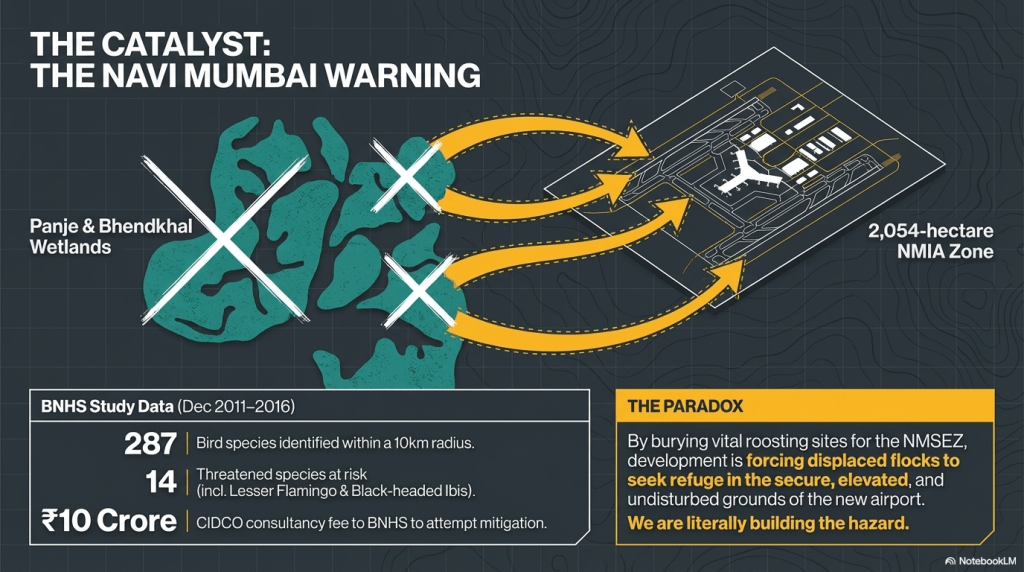
Warnings have been raised that the upcoming Navi Mumbai International Airport could face serious wildlife-hazard exposure because of the destruction of surrounding wetlands and mangroves. Environmental groups have argued that the burial of ecologically important sites such as Panje and Bhendkhal, along with wider habitat disruption in the area, is displacing large numbers of resident and migratory birds. A five-year Bombay Natural History Society study identified 287 bird species within 10 km of the airport site.
The safety concern is straightforward. When natural habitats are degraded or erased, birds do not simply disappear. They relocate. And when relocation occurs near a new airport, the risk is transferred directly into the operational environment.
CIDCO’s decision to fund a long-term BNHS consultancy reflects recognition of the issue. But monitoring alone is not mitigation. If critical roosting and feeding grounds continue to be altered while the hazard is merely studied, then the response risks becoming procedural rather than preventive. In that case, the system is not reducing bird-strike risk. It is managing its appearance.
This failure is not only ecological and operational. It is also economic.
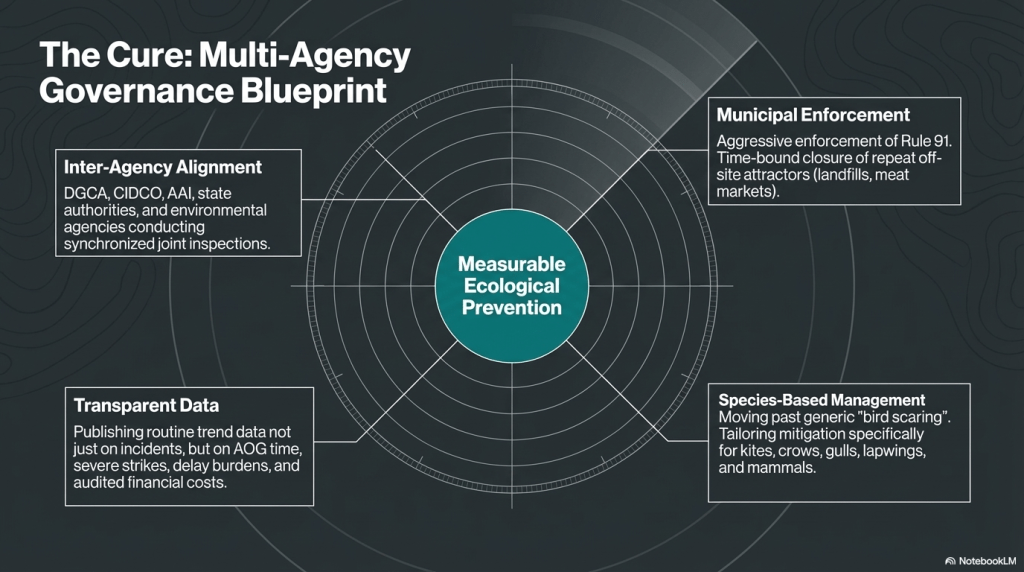
Bird strikes impose major costs on airlines through inspections, repairs, delays, diversions, aircraft-on-ground time, network disruption, and passenger inconvenience. India does not yet publish a transparent and audited annual loss series comparable to the data available in some other jurisdictions. That itself is a weakness. Poor financial visibility often dilutes accountability.
Still, the public figures available are sufficient to show that the burden is not trivial. Reported DGCA-linked estimates, including losses exceeding ₹25 crore in 2014, indicate that preventing bird strikes at source is not only a safety priority but also a cost-control imperative for the industry.
🦅 Falconry: A Weapon, Not a Cure-All
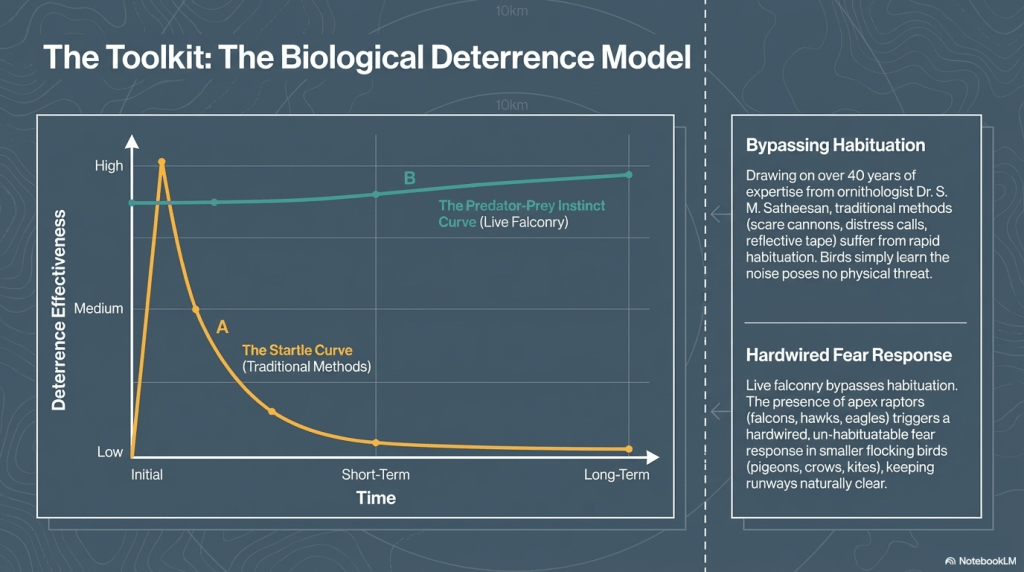
As conventional methods such as distress calls, pyrotechnics, and scare devices lose effectiveness, falconry deserves serious attention. The use of trained raptors to disperse smaller birds is an intelligent, non-lethal biological method, and it has been used effectively at airports such as Changi, Heathrow, and Vancouver. There is also growing interest in related ideas, including robotic falcons and the possible use of raptors in drone deterrence.
But falconry must be kept in perspective.
A falcon can disperse birds from a runway environment. It cannot remove an open garbage source. It cannot regulate illegal slaughter activity. It cannot fix stagnant water, unmanaged wetlands, or weak civic enforcement. Falconry is a sophisticated and useful tool, but it cannot compensate for a degraded urban ecology outside the airport boundary.
If falconry is adopted while the larger attractants remain untouched, then the exercise risks becoming visible safety theatre rather than genuine risk reduction.ls.
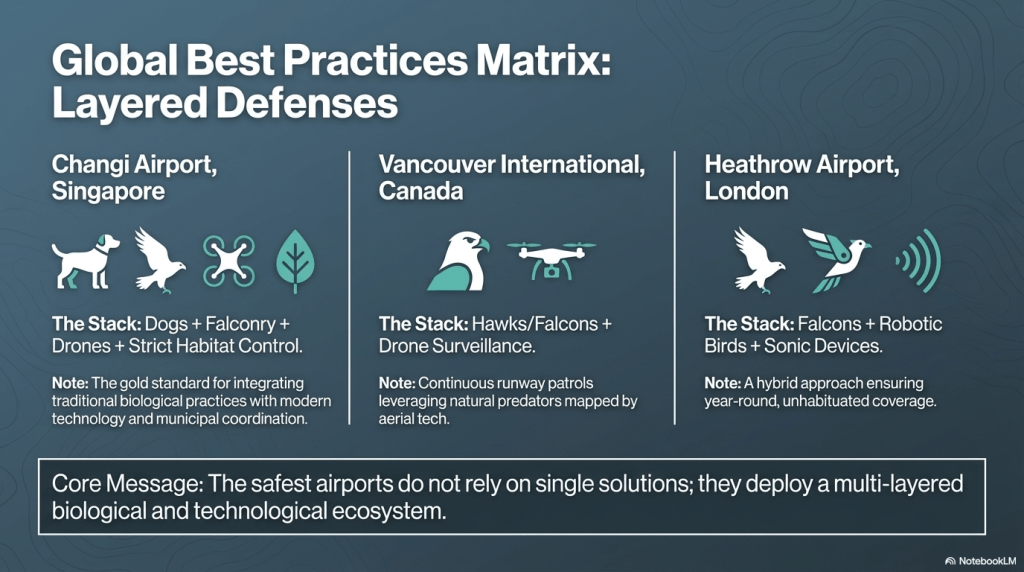
But here is the hard truth: A falcon cannot clean up a garbage dump.
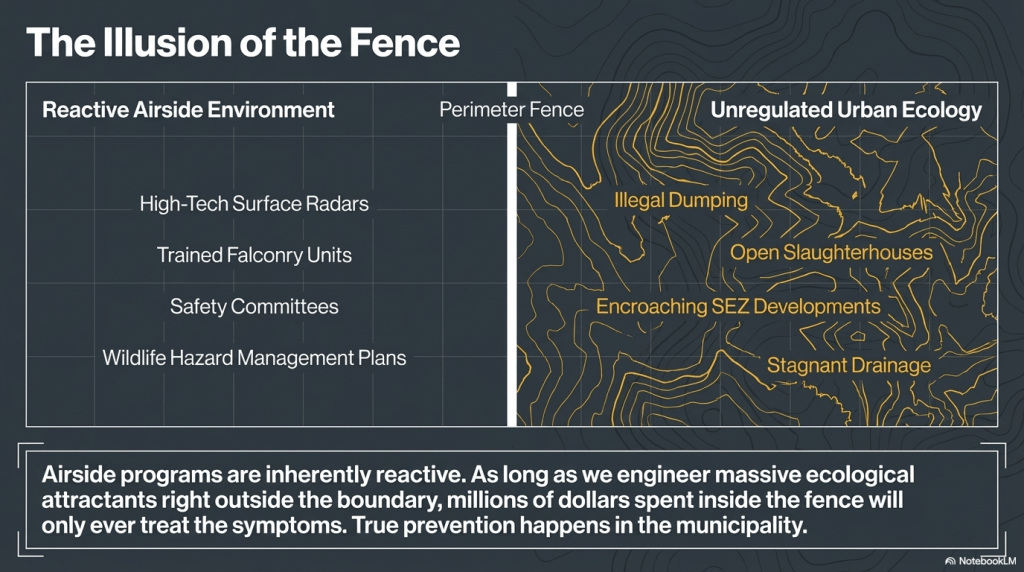
Falconry is an intelligent, specialized tool, but it cannot compensate for open slaughter residues, unmanaged waterlogging, or poor municipal enforcement. If we rely on falcons while ignoring the urban rot just beyond the fence, we are engaging in visible safety theater while leaving the root problem entirely untouched.
The Bottom Line
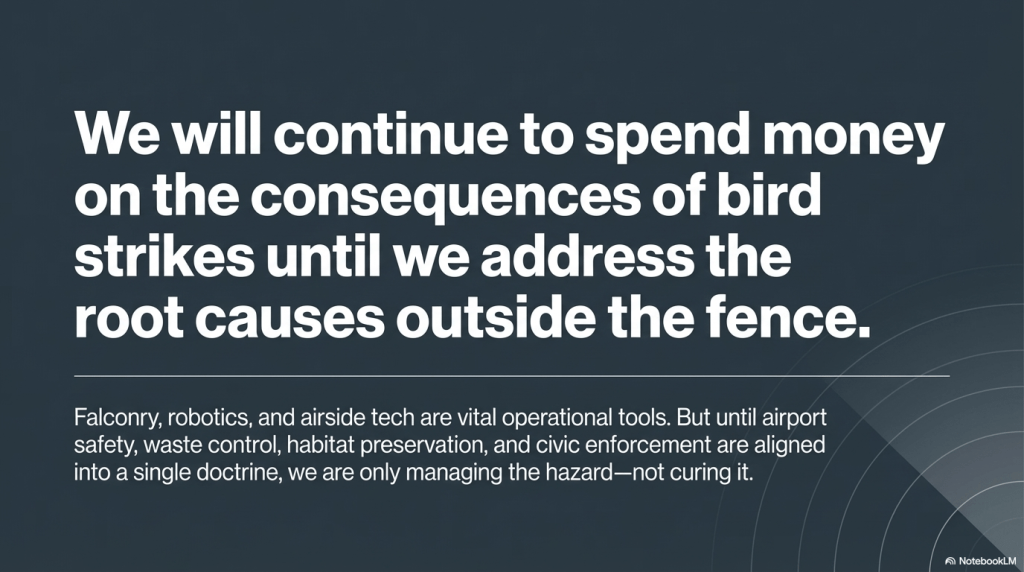
ndia has moved toward more formal Wildlife Hazard Management Plans, and that is welcome progress. But progress on paper is not enough. Unless airport operations, land use, waste control, habitat management, and municipal enforcement are brought into genuine alignment, the country will remain focused on treating symptoms rather than causes.
Bird strikes must now be seen for what they really are: not only aviation events, but failures of urban governance and environmental discipline.
If the law outside the airport fence is not enforced with the same seriousness as the procedures inside it, then the hazard will continue to grow — and the cost will continue to be paid in operational disruption, economic loss, and avoidable safety exposure.
Discover more from Safety Matters Foundation
Subscribe to get the latest posts sent to your email.

