


Airline Safety Culture: Why Airlines Stumble During Rapid Expansion and Mergers


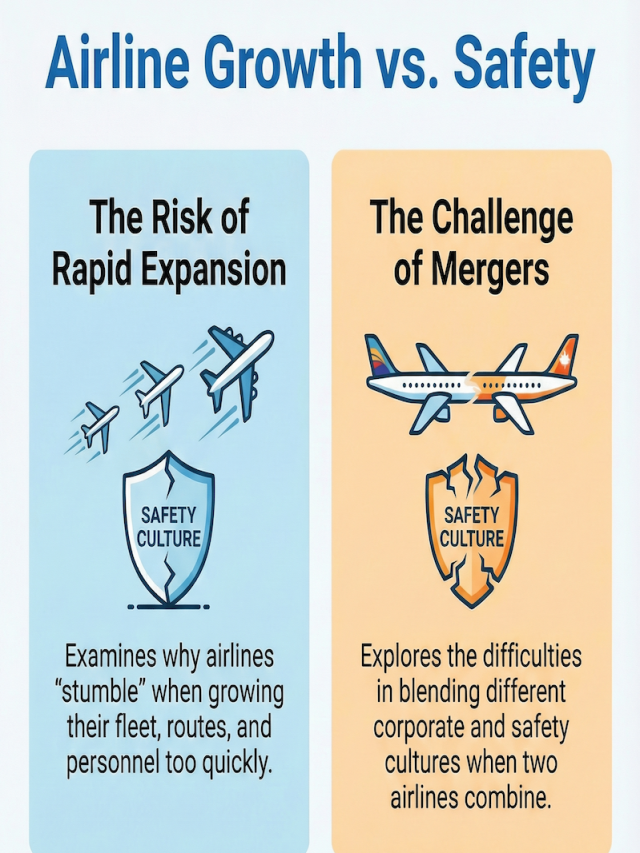
Introduction: Why rapid airline expansion often undermines safety
Airline safety culture is the invisible foundation that determines whether growth strengthens an airline or quietly destabilises it.
In aviation, there is a well-known human trap: the aircraft is close to landing, the runway is in sight, and the pressure to complete the task is high. This is precisely when risk peaks. Many accidents and serious incidents do not occur because pilots lack skill or intent, but because fixation replaces awareness. The mind narrows, alternatives fade, and speed feels reassuring.
Organisations behave the same way.
During rapid expansion, mergers, or high-visibility turnarounds, airlines often mistake motion for progress. Fleet size, route announcements, and brand visibility become the organisational equivalent of “getting the aircraft on the ground at all costs”. Meanwhile, less visible but safety-critical elements — training depth, fatigue margins, trust, and culture — begin to erode quietly.
This article is not about aircraft types or individual incidents. Examples from line operations or training are used only as signals. The real subject is the system, and how airline safety culture is stressed when expansion outruns foundations.
Organisational myopia in aviation: a human factors problem, not a moral failure
In human factors, myopia does not imply incompetence or bad intent. It refers to narrow framing under pressure — the tendency to focus on what is urgent, measurable, and visible, while underweighing slower, less tangible risks.
In airlines, organisational myopia commonly appears as:
- Obsession with growth metrics and market position
- Underestimation of training lag and fatigue accumulation
- Belief that culture and trust will “settle later”
- Overconfidence in generic management skills over aviation depth
Safety researchers such as James Reason and Rasmussen showed long ago that organisations rarely fail suddenly. They drift. Each step seems reasonable at the time. Only later does the full trajectory become obvious.
In cockpit terms, this is cognitive lock-up — now occurring at organisational scale.

Rapid airline expansion before stabilisation: a classic safety failure pattern
Aviation is unforgiving about sequencing. You cannot:
- Expand faster than you can train
- Add complexity before standardisation
- Demand productivity before restoring trust
Yet during airline turnarounds and mergers, this sequence is frequently inverted.
The unsafe inversion
- Branding before basics
- Network growth before instructor capacity
- New aircraft before SOP maturity
- Targets before fatigue margins
This pattern is visible across aviation history — from failed airline expansions to manufacturer production crises. The explanation is often framed as “commercial necessity”. Human factors offers a simpler truth: pressure compresses judgment.
Airline mergers and culture: grief, identity loss, and silent resistance
One of the most underestimated risks in airline mergers and takeovers is cultural grief.
From the outside, a merger is a strategic event. From inside, especially for long-serving pilots, engineers, instructors, and cabin crew, it often feels like a loss.
Airlines are not just employers. They are communities of practice built on:
- Shared identity and pride
- Informal safety knowledge
- Stories of past mistakes, recoveries, and close calls
When outsiders take over after decades, people experience:
- “This is no longer our airline”
- “Our experience no longer matters”
- “Everything we stood for is being erased”
This reaction is not immaturity or resistance. It is human attachment to meaning.

Airline takeovers: how loss of identity affects safety behaviour
In safety-critical systems, loss of identity has direct operational consequences.
Crews rarely rebel. Instead, they withdraw:
- Reduced discretionary effort
- Silent compliance without commitment
- Reluctance to speak up
- Passive resistance to change
Safety does not deteriorate through defiance, but through emotional disengagement.
This is why airline safety culture is so fragile during transitions — and why it must be handled deliberately.
Why silence after mergers is a major aviation safety risk
Human factors research shows that resistance during mergers rarely looks dramatic. It looks quiet.
- Minimal compliance
- Emotional shutdown
- Cynicism masked as humour
In hierarchical organisations, silence is often mistaken for alignment. In reality, silence is often grief without a voice.
For aviation, this is dangerous. Safety depends on people going beyond checklists — challenging, mentoring, and escalating concerns early. When that discretionary layer disappears, the system becomes brittle.

Training lapses in expanding airlines: symptoms of deeper system stress
During rapid expansion or cultural disruption, airlines often observe:
- Inconsistent training outcomes
- Instructor overload
- Compressed conversions
- “Tick-box” checking replacing learning
These are commonly labelled as training failures. In truth, they are organisational stress signals.
Training lapses occur when:
- Time pressure dominates learning
- Instructors are treated as production bottlenecks
- Weaknesses are deferred to line operations
This creates training debt — invisible early, expensive and dangerous later.
Why revenue operations reveal hidden safety weaknesses
Line events often attract attention because they are visible. But they are effects, not causes.
Revenue operations expose what simulators cannot:
- Fatigue accumulation
- Commercial pressure
- Reduced cognitive bandwidth
- Cultural reluctance to stop, question, or reset
When airline safety culture is weakened by speed, mergers, or loss of trust, line operations reveal it first. The aircraft type is incidental. The system is the story.
Air India as a case study in airline transition risk
Air India’s recent transition illustrates a universal pattern, not a unique failure.
A legacy airline with:
- Deep historical identity
- Accumulated organisational trauma
- High public and political expectations
- Pressure to demonstrate rapid turnaround
faces immense cognitive and cultural load.
The risk is not bad intent. The risk is that:
- Weak signals are reframed as “transition noise”
- Fatigue and strain become normalised
- Cultural loss goes unacknowledged
When people feel unheard, they stop contributing beyond the minimum. Safety becomes procedural, not alive.
Indian wisdom and aviation leadership: restraint before acceleration
Indian philosophy offers a lens modern management often overlooks.
The Gita distinguishes between:
- Rajas — restless action, ambition, speed
- Sattva — clarity, balance, restraint
Aviation demands Sattva-first leadership.
Yogaḥ karmasu kauśalam — excellence lies in skillful action, not hurried action.
In airline leadership, restraint is not weakness. It is risk management.
Why airline safety culture repair is accident prevention
Addressing culture during mergers is not about sentiment. It is about risk control.
- Disengaged crews miss weak signals
- Cynical instructors stop mentoring
- Silenced engineers escalate only when failures become obvious
Every one of these increases the probability that routine operations begin producing abnormal outcomes.
Culture repair is therefore accident prevention.
Conclusion: earning the right to expand safely in aviation
Airlines do not stumble because they aim high. They stumble because they aim fast before the system is ready.
Mergers and expansion succeed not when people comply, but when they re-commit.
That recommitment cannot be commanded. It must be earned — through patience, listening, respect for legacy identity, and deep investment in foundations.
That is the core message of mindFly: airline safety culture is not built by machines or slogans, but by human beings who feel seen, heard, and trusted.
For deeper exploration of these themes, see Capt. Amit Singh’s book“mindFly: Follies, Realities and Human Factors.”
Discover more from Safety Matters Foundation
Subscribe to get the latest posts sent to your email.
Leave a Reply